Earliest copy of Mona Lisa found in Prado
Experts say the painting was completed at the same time as Leonardo’s original
by: Martin Bailey,The Art Newspaper, Issue232
February 2012–A copy of the Mona Lisa has been discovered in the Prado which was painted in Leonardo’s studio—created side by side with the original that now hangs in the Louvre. This sensational find will transform our understanding of the world’s most famous picture.
Conservators at the Prado in Madrid recently made an astonishing discovery, hidden beneath black overpaint. What was assumed to be a replica of the Mona Lisa made after Leonardo’s death had actually been painted by one of his key pupils, working alongside the master. The picture is more than just a studio copy—it changed as Leonardo developed his original composition.
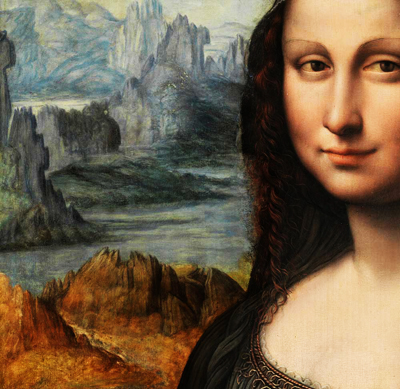
The final traces of overpaint are now being removed by Prado conservators, revealing the fine details of the delicate Tuscan landscape, which mirrors the background of Leonardo’s masterpiece. Darkened varnish is also being painstakingly stripped away from the face of the Mona Lisa, giving a much more vivid impression of her enticing eyes and enigmatic smile.
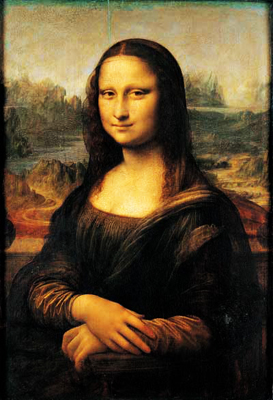
In the Louvre’s original, which will not be cleaned in the foreseeable future, Lisa’s face is obscured by old, cracked varnish, making her appear almost middle aged. In the Prado copy we see her as she would have looked at the time—as a radiant young woman in her early 20s.
Leonardo da Vinci, and particularly his masterpiece the Mona Lisa, attracts endless sensationalist theories. However, the discovery of the contemporary copy has been accepted by the two key authorities, the Prado and the Louvre.
Uncovering the truth
Until recently, curators at the Prado had no idea of the significance of their copy of the Mona Lisa. There are dozens of surviving replicas from the 16th and 17th centuries. The Madrid version was believed by some specialist to have been painted fairly early, but the absence of the landscape background meant that it aroused little interest (there is no substantive entry on it in the Prado’s collection catalogues).
Although the portrait is finely painted, the dull, black background had a deadening visual effect on the image of the young woman. The sitter is generally believed to represent Lisa Gherardini, the wife of the Florentine cloth merchant Francesco del Giocondo.
The Prado’s painting was until recently assumed to be on oak (rarely used in Italy at the time) and therefore a work by a northern European artist. José Ruiz Manero, the author of a study of Italian art in Spanish collections, concluded that the picture was Flemish.
Last year, the panel was examined and found to be walnut, which was used in Italy (as is poplar, used for the original of the Mona Lisa). In size, it is close to that of the original: the Louvre’s painting is 77cm x 53cm and the Prado’s copy 76cm x 57cm.
In a paper presented two weeks ago at a technical conference at London’s National Gallery, coinciding with its exhibition “Leonardo da Vinci: Painter at the Court of Milan” (until 5 February), conservators revealed that they had discovered that the black background was a later addition. This conference was not covered in the media (for a report, see our February print edition).
A striking photograph was presented at the conference, showing the picture’s condition after 90% of the black overpaint had been removed, leaving just a small section in the upper right. Visually, the landscape transforms the work, bringing the picture to life.
There was an even greater surprise: infrared reflectography images of the Prado replica were compared with those obtained in 2004 from the original of the Mona Lisa in the Louvre. This process enables conservators to peer beneath the surface of the paint, to see underdrawing and changes which evolved in the composition.
The underdrawing of the Madrid replica was similar to that of the Mona Lisa before it was finished. This suggests that the original and the copy were begun at the same time and painted next to each other, as the work evolved.
Identifying the painter
It is quite possible that Leonardo’s assistant met Lisa and may even have been present when she sat for the master. Although no drawings survive, Leonardo probably began by sketching her face and pose. She may also have come to the studio when finishing touches were being applied to the face in the painting.
The Prado’s technical specialist Ana González Mozo describes the Madrid replica as “a high quality work”, and in the paper she presented at the London conference, she provided evidence that the picture was done in Leonardo’s studio. The precise date of the original is uncertain, although the Louvre states it was between 1503 and 1506.
Bruno Mottin, the head conservator at the Centre de Recherche et de Restauration des Musées de France, believes that the most likely painter of the Prado copy was one of Leonardo’s two favourite pupils.
Mottin proposes that it was either Andrea Salai, who originally joined Leonardo’s studio in 1490 and probably became his lover, or Francesco Melzi, who joined around 1506. If the Prado replica is eventually attributed to Melzi, it suggests a late date for the original.
What the copy reveals
The Madrid copy of the Mona Lisa is important for what it tells us about Leonardo’s studio practice. The production of a second version, painted alongside the original, is intriguing. It adds credence to Martin Kemp’s theory that Leonardo may also have had a hand in both versions of The Madonna of the Yarnwinder, 1501-07, one owned by the Duke of Buccleuch and the other by a New York private owner (formerly in the Lansdowne collection).
But what is most exciting about the Prado replica is what it reveals about Leonardo’s original. In the Madrid copy there are areas that are better preserved than in the Louvre painting. The replica gives us more detail of the spindles of the chair, the frill on the edge of the fabric on Lisa’s chest and the semi-transparent veil around her left shoulder, arm and elbow.
The Prado’s curator Miguel Falomir believes the replica can probably be identified as a portrait listed in the 1666 inventory of Madrid’s Alcazar Palace, although it remains unclear when it first reached the Spanish royal collection.
Coming into the light
Falomir suspects the black overpaint was probably added in the mid-18th century. The reason for this addition is obscure, since the background landscape remained in good condition and Leonardo’s original painting was already very highly regarded. The overpaint may have been added to integrate the copy into an interior with other portraits set against dark backgrounds.
During the past few months, this black covering has been painstakingly stripped away at the Madrid conservation studio, with the final area of dark overpaint due to be removed in the next few days. Later varnish has also been taken away from the rest of the picture, most importantly the face.
The fully conserved replica is expected to be unveiled at the Prado in Madrid in mid-February. It is then due to be loaned to the Louvre in Paris, as a late addition to its exhibition on “Leonardo’s Last Masterpiece: The Sainte Anne” (29 March-25 June). There it will be seen in the same gallery as the original, giving specialists and visitors the first chance to compare the two works. After 500 years, the two versions of the Mona Lisa from Leonardo’s studio will be reunited again.
See also:
• The National Gallery’s blockbuster exhibition could mark a turning point for Leonardo scholars
SOURCE: http://www.theartnewspaper.com/articles/Earliest-copy-of-Mona-Lisa-found-in-Prado/25514