Purveyor of Knowledge and Emerging Publisher of Content and Visually Driven Books

January 9, 2026

Antiquity: The Hapao-Hungduan Bul-ul


ANTIQUITY: THE HAPAO-HUNGDUAN
BUL-UL
by: Rico Acda

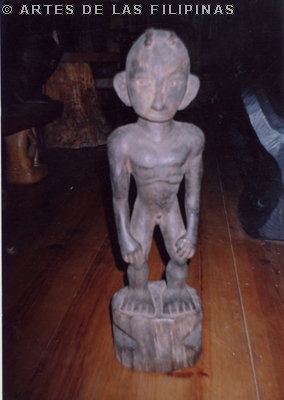
The Hapao bul-ul is normally carved in a standing position. Its knees are slightly flexed with its hands resting on the kneecaps. Each year, for about a century now, the bul-ul’s real life family– the Bumatang’s of Magoc, Hungduan, sponsors a village festival in honor of the bul-uls as well as the appeasement of it. The family was convinced that unless it gave the annual party which involves the butchering, roasting, and dispensing of several pigs, sickness would strike the household. This is an old and strictly followed tradition the family observed.

Another Hapao example is the binakle, which has imparted to these bul-ul their distinctive white-blotched surface. This is a religious observance they follow once a year at harvest time in some parts of Ifugao. They slather on bul-ul as nourishment coasting of blood or rice wine. This pair of bul-ul was carved by Yoyog of Pakawal, Hungduan in 1910 and was used yearly in religious ceremonies — the last occasion being the harvest canao in 1998.
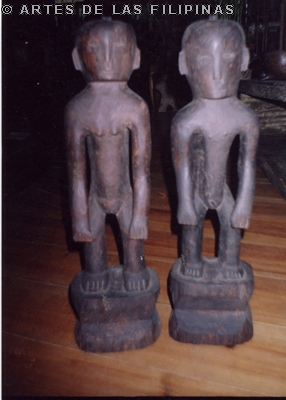
It is apparent that these bul-uls are ceremonial type because of the color of the whole body. The unequal blotched of the surface is an indication that animal blood was being bathed around the figure. The Hapao bul-ul usually has a small patched of hair pegged on top of the head.

The muscularity of the first bul-ul being noted here is somewhat being clearly defined by the carver of Magoc while there is less muscularity in the second one. The second type is somewhat rendered in an elongated body and peripheral arms. It has also a very minimal configuration of ears, nose, eyes, and lips and a portion of the head is somewhat recognizable.

(Rico Acda has written numerous articles on the subject of Bul-ul and other antiquities. He is completing his masteral studies in the University of the Philippines.)

The San Miguel Arcangel Parish Church Argao, Cebu
June 2016--The construction of this beautiful Baroque Rococo church was begun in 1734, the year after the parish was established by the Augustinian Order and was completed in 1788. On the bicentenary of her completion-...
lee mas...
books
The Philippine Art Book (First of Two Volumes) - Book Release
April 2022 --   Artes de las Filipinas welcomed the year 2022 with its latest publication, The Philippine Art Book, a two-volume sourcebook of Filipino artists. The data gathering for this book began in the ye...
lee mas...
Nonoy Marcelo's Life and Art
Nonoy Marcelo’s Life and Art by: Christiane L. de la Paz INSERT 5-1 INSERT 10-4
lee mas...
REVELATIONS A Jaime de Guzman Retrospective
Normal 0 false false false FIL-PH X-NONE X-NONE /* Style Definitions */ table.MsoNormalTable {mso-style-name:"Table Normal"; mso-tstyle-rowband-size:0; mso-tstyle-colband-size:0; mso-style-noshow:yes; mso-style-priority:99; mso-style-parent:""; mso-padding-alt:0in 5.4pt 0in 5.4pt; mso-para-margin-top:0in; mso-para-margin-right:0in; m...
lee mas...
Lex Tuviera's Breezy Beach and Secret Gardens
Lex Tuviera’s Breezy Beach and Secret Gardens by: Christiane de la Paz September 2014–In 1978, Lex Tvbiera received his first commissioned work from Emmi Barbin, an ardent art collector based...
lee mas...
Alfredo Roces: Man of Arts and Letters (Second of Two Parts)
February 2016--Alfredo Roces holds a prominent place in the history of Philippine art. He is a painter who started with a figurative style but soon began to amalgamate Expressionism, Fauvism and Impressionism in his paint...
lee mas...
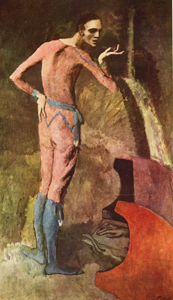
Picasso's "The Actor" Painting Accidentally Ripped by A Woman at the Met
Pablo Picasso’s “The Actor” painting which depicts a gaunt male figure in a dusty pink costume was gouged on Friday, January 25 2010 at the Metropolitan Museum of Art when a museumgoer fell into the artwork...
lee mas...
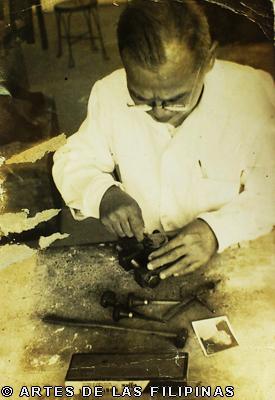
Ambrocio Mijares Morales (1892-1974): Engraver, sculptor, art professor and supporter of the Katipunan
May 2014--Engraver, sculptor, art professor and supporter of the secret organization, the Kataas-taasan, Kagalang-galangang Katipunan ng mga Anak ng Bayan (KKK), Ambrocio Morales’s earliest recorded sculpture in 1927 was the bust of Bonifacio Bedaña (alias Suyod), the president of th...
lee mas...
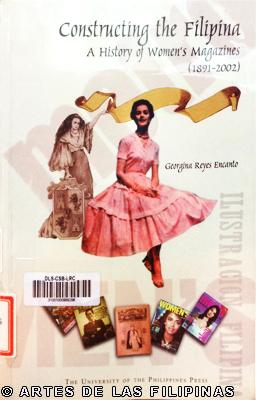
A Critical Essay on Constructing the Filipina: A History of Women�s Magazines (1891-2002)
April 2013--Constructing the Filipina: A History of Women’s Magazines from 1891-2002 by Georgina Reyes Encanto is a first attempt to record the history of Women’s magazines in the historical-feminist perspe...
lee mas...
angono0211
The Angono Petroglyph
The Angono Petroglyph by: Teta Limcangco     The Angono Petroglyph is a recent archeological breakthrough during the 80’s found in the mountainside of Angono and Binangonan by Carlo “Botong” Francisco....
lee mas...