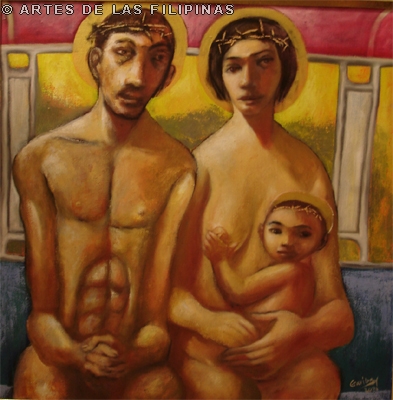
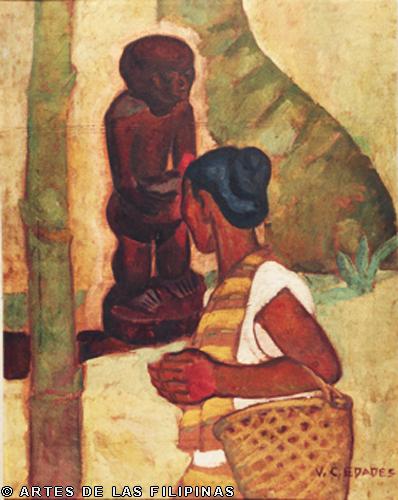
Bulul at Babae by Victorio Edades
UP Vargas Museum Art Collection
Farewell, (Or Underground With) Material Possessions
by DR. JAIME C. LAYA
May 2, 2011, Manila Bulletin
MANILA, Philipines — Possessors ordinarily ignore the prayerful’s admonition of detachment from material possessions. With the National Cultural Heritage Act (R.A. No. 10066, signed into Law in March 2010), they won’t.
The Law specifically mentions collectors (“any person who or institution that acquires cultural property for purposes other than sale”) and dealers (“natural or juridical persons who acquire cultural property for the purpose of engaging in the acquisition or disposition of the same”). (Sec. 3-g and p)
As written, it covers just about everything man-made, since “cultural property” is, “all products of human creativity by which a people and a nation reveal their identity, including churches, mosques, and other places of religious worship, schools and natural history specimens and sites, whether public or privately-owned, movable or immovable, and tangible or intangible.” (Sec. 3-o)
Specifically enumerated are archival material, books, manuscripts, periodicals, newspapers, libraries, electronic records, movable and immovable cultural property pertaining to Philippine history and heroes. Also mentioned are the fine arts (e.g., paintings, sculpture, photographs), archaeology, anthropology, botany, geology, zoology, astronomy, languages, performing arts. (Sec. 31)
How geologists, zoologists and astronomers enter the picture is unclear, but surely Pinoy cooks, fashion designers, furniture makers, woodcarvers, weavers and embroiderers, jeepney painters, etc. creatively reveal aspects of our national identity.
Objects designed and/or manufactured abroad (e.g., stamps and coins) could also express Filipino identity. On the other hand, excavated ceramics, being Chinese (Sung and Ming), Vietnamese or Thai, hardly express Filipino national identity, something that might be argued excludes them from “cultural property” as defined.
The Law requires “cultural property deemed important to cultural heritage” to be listed in a Philippine Registry of Cultural Property within three (3) years (Sec. 14-e). Works of National Artists, Manlilikha ng Bayan and national heroes, as well as archival material over 50 years old are automatically considered important. Identifying items for registration won’t be easy but Sec. 49 says objects concealed from registration “shall be summarily confiscated and forfeited” and the owner fined (Sec. 49). Once registered, the property may be taken abroad only for temporary “scientific scrutiny or exhibition” and should be returned. (Sec. 11, 23 and 48-f)
Dealers of cultural property (including books, newspapers, CDs?) must be licensed, are subject to inspection and should submit a quarterly inventory with a history of each item. (Sec. 10)
Government cultural agencies, through the National Commission for Culture and the Arts, have “visitorial powers” over certain types of cultural property and with prior written consent of private owners, also over “collections or objects that may be categorized as cultural property.” (Sec. 27)
Cultural agencies also “have the power to deputize the Philippine National Police, the National Bureau of Investigation, theArmed Forces of the Philippines, the Philippine Coast Guard, and other local or national law enforcement agencies.” (Sec. 27)
There is no guarantee, but important cultural properties may receive funding for “protection, conservation and restoration.” (Sec. 7) However, rather than face off with the Marines, collectors just might say farewell to material possessions. Either that or like dissidents, go underground.