Purveyor of Knowledge and Emerging Publisher of Content and Visually Driven Books

March 5, 2026

The History and the 1930s Graduates of the University of the Philippines School of Fine Arts

The History and the 1930s Graduates of the University of the Philippines School of Fine Arts (First of Three Parts)
by: Christiane L. de la Paz

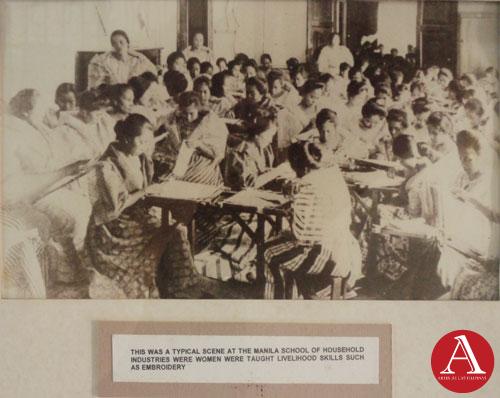
February-March 2014--The School of Fine Arts was established by authority of Act No. 1870, founding the University of the Philippines which was enacted by the Philippine Assembly on June 18, 1908. The School was opened to students in June, 1909. It was first housed in a building rented by the University at 931 Calle Resurreccion Hidalgo, Quiapo. In May, 1926, it moved to 1001 California Street, Ermita, and in November, 1933, it moved to Villamor Hall where it is present housed.


The object of the School, besides the teaching and development of the graphic and plastic arts in their various and manifold branches, which is its chief objects, is “to exert an influence toward the advancement and refinement of those industrial trades which are of an artistic nature; as gold and silver work, ceramics, embroidery, lace-making, and metal work.”

The 1930s Graduates


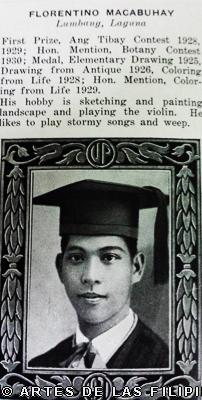
Florentino Macabuhay (1931)
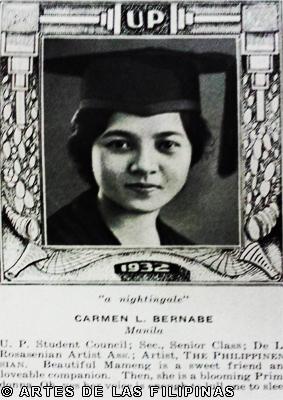

Carmen Bernabe
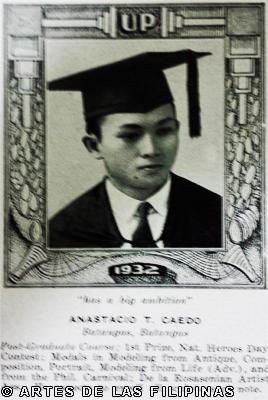

Anastacio Caedo (1932)
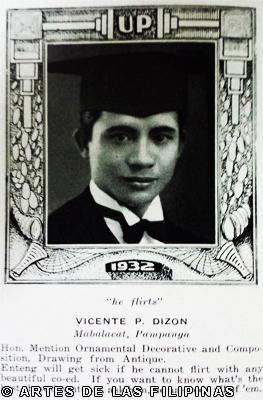

Vicente Dizon (1932)
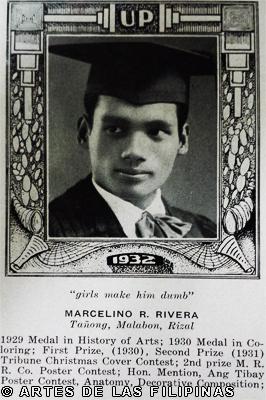

Marcelino Rivera (1932)
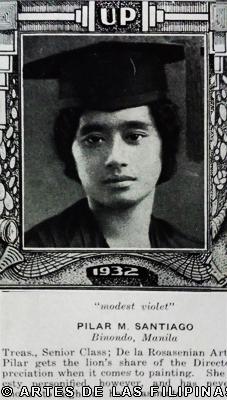

Pilar Santiago (1932)
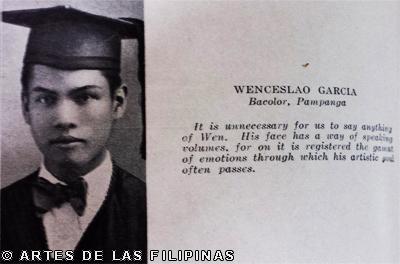

Wenceslao Garcia (1933)
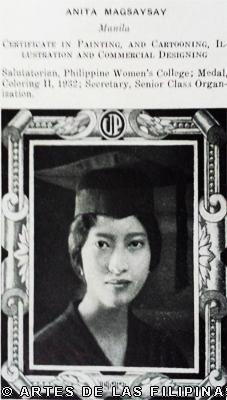

Anita Magsaysay (1933)
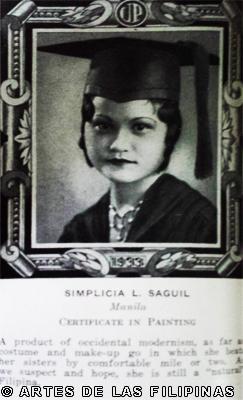

Simplicia “Nena” Saguil (1933)
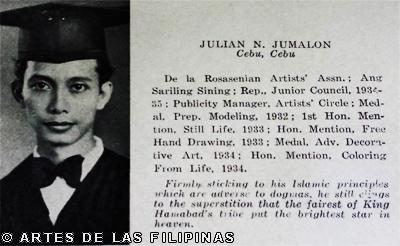

Julian Jumalon (1934)
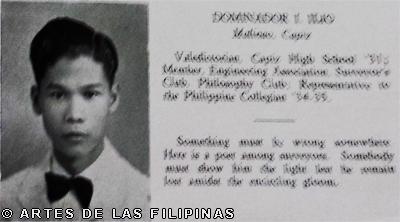

Dominador Ilio (1935)
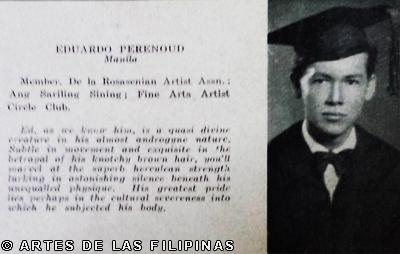
Eduardo Perrenoud (1935)

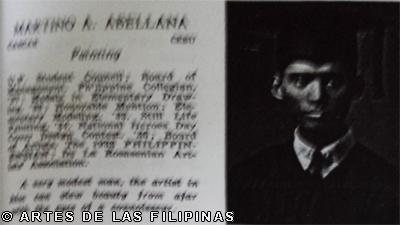
Martino Abellana (1938)


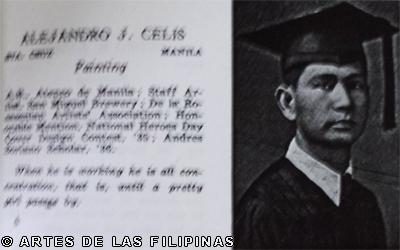
Alejandro Celis (1938)

Guillermo Estrella Tolentino: A Classic of His Time
May 2011-- Guillermo Estrella Tolentino was born in Malolos, Bulacan on 24 July 1890.  He was the fourth of eight children.  His father was a tailor, whose only artistic trait is the love of playing the guitar. ...
lee mas...
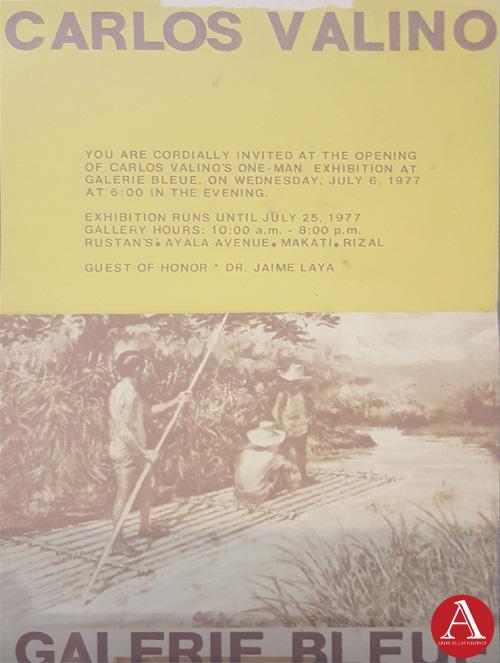
Carlos Valino Jr. Retrospective Exhibition Obra ni Val
June 2017--Valino grew up in Pre-war Philippines, in the small town of Aduas, Cabanatuan, Nueva Ecija. He survived the Japanese occupation, preserved as a self-taught young artist, and entered the University of the Phili...
lee mas...
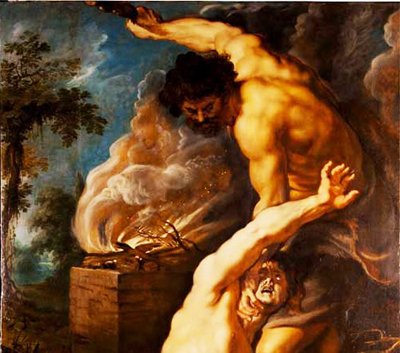
Rubens masterpiece "made for public" Artist chose "cheap and cheerful" wood
January 2012--The restoration of a painting by Rubens from London’s Courtauld Gallery has revealed that the work was probably not a commission, but created for the speculative market. Cain Slaying Abel, around 1608-...
lee mas...
HERNANDO R. OCAMPO
HERNANDO R. OCAMPO
BIO – DATA (as of March 12, 1971) I. Date and Place of Birth: April 28, 1911, Sta. Cruz Manila II. Name of Father: Emilio Ocampo y Salterio III. Name of Mother: Delfina Ruiz y Santos IV. Name of Wi...
lee mas...
Jose Zabala Santos (1911-1985)
March 2013--Jose Zabala Santos or “Mang Pepe” to his neighbors in Kuatro Kantos, Malabon, was born in Calumpit, Bulacan on July 20, 1911. He acquired his early drawing skills from his mother whose avocation i...
lee mas...
Galleria Taal's Select Photo Exhibition
December 2016--This ancestral house was built circa 1870 by Domingo Ilagan and Maria Martinez (who died both in 1903). They had six children: Aniceto Ilagan, Rosario I, Villanueva, Candida I. Barrion, Conception I. Sison...
lee mas...
Porfirio Castaneda on His Tatay, Dominador Castaneda
Porfirio Castañeda on His Tatay, Dominador Castañeda by: Christiane L. de la Paz March 2016–Dominador Castañeda spent his early education at the Escuela de Bellas Artes in Quiapo, Manila. In 1924,...
lee mas...
Shouting in Bronze: The Lasting Relevance of Andres Bonifacio and His Monument in Caloocan
Amidst the concrete jungle in the middle of the city of Caloocan, amongst the smog of pollution, stands the dignified figure of Andres Bonifacionational hero, Founder of the Katipunan, Father of the Filip...
lee mas...
Marcel Belleza Antonio: The Son, The Man, The Painter (First of Two parts)
The works of Marcel Antonio belong to an expressive and non-literary tradition of storytelling. He began his career in 1983 while still a sophomore at the University of the Philippines College of Fine Arts....
lee mas...
federico
FEDERICO SIEVERT'S PORTRAITS OF HUMANISM
JUNE 2024 – Federico Sievert was known for his art steeped in social commentary. This concern runs through a body of work that depicts with dignity the burdens of society to offer a counter-narrative to demagogues and s...
lee mas...