How did you get started with art dealing?
I was a Fine Arts graduate from the College of the Holy Spirit. I was 19 when I finished school and my parents thought I was too young to work here (Manila) so I went back to Davao. I taught Humanities and Art Appreciation at the University of Mindanao from 1972-1975. I got bored and restless. I wanted to do what I studied for so I came back to Manila to work in an advertising agency. As an artist in an advertising company, you always beat the deadline. I worked long hours. I dealt with all sorts of people I was not used to it and it was a different environment. It was a man’s world. In less than a year, I quit. I then went into textile designing and stayed for four years. In 1979, I worked for Sining Kamalig, an art gallery in Taft Avenue as a gallery assistant. My work was cleaning and fixing the stockroom; doing the inventory which helped me in my job because I got to know the artworks; putting up shows; selling artworks which taught me how to deal with people; but after four years of working, I got tired of it, too.
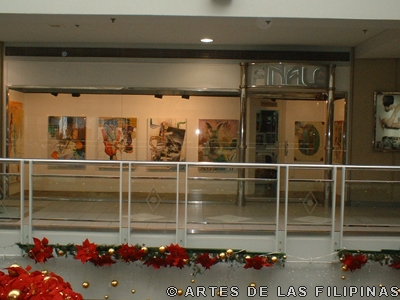
After that, I wanted a different job but Ray Albano, who was the museum director of CCP suggested, “Why don’t you put up your own gallery?” He said it was going to be different because I was going to work for myself. Three of us put up the Finale Art File: Ray Albano, as the consultant, Inday Tiansay, the moneybag) and myself who was in charge of exhibitions and sale. The three of us started Finale in 1983. Initially, we were marketing the works of artist friends, whom we have worked with at Sining Kamalig. Ben Chan of Bench gave us a space at his Finale Boutiques at the Atrium, Makati. A wall and a stockroom. A few months later, we moved to Sunvar Plaza in Pasay Road and had a real gallery space. We formally opened Finale Art File with a show, ” Four Masters, Four Worlds” with works of top artists, Cesar Legaspi, Ang Kiukok, Malang and Romulo Olazo. That made Finale Art File going. Working to make Finale work was fun. The big name artists supported us. In turn, we promoted young artists. We made a market for them.
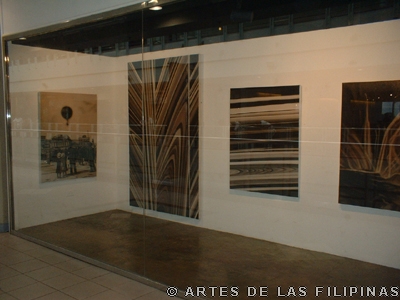
When I started working in a gallery, I couldn’t appreciate abstract works. I could not relate to it. I only appreciated representational paintings which I understood – figurative, landscapes, and still lifes. With constant exposure to abstract works, I learned to appreciate it. Then I started to understand conceptual art. Installation, photography, video, etc. I developed a liking to contemporary art.
Tough to sell. We had to survive. The early 1980s was unstable. Coups, rallies, political chaos, the economy was bad, they all affected the business. We did well though when there was a bank run. People did not know where to put their money. We were one of the lucky ones, they invested on art.
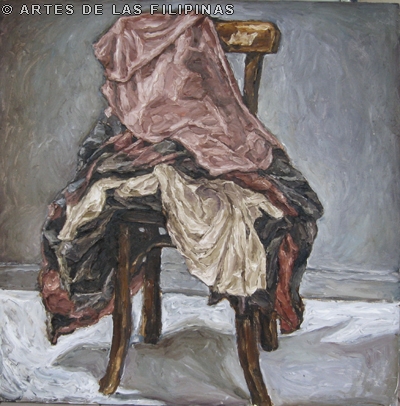
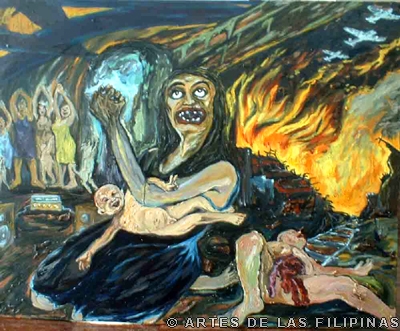
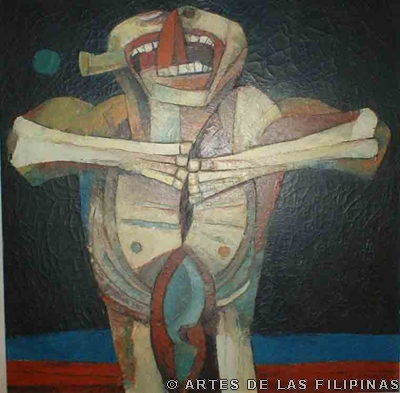
Elaine Navas
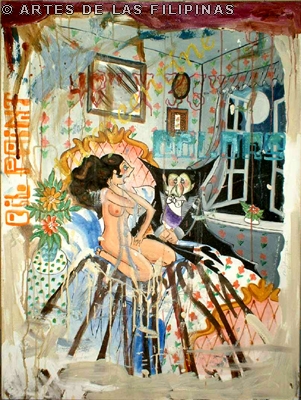
“Artifact #1”
48 x 48 inches
2006
Oil on Canvas
We were selling the works of the big names – Legaspi, Kiukok, Malang, Olazo, Bencab, Juvenal Sanso, Agustin Goy, Antonio Austria, some of the artists from the then Saturday Group, who met at Finale for sketching sessions. The young artists, Popo San Pascual, Francesca Enriquez, Soler Santos, RM de Leon, Pardo de Leon, Jun Domingo among others. Some works from the secondary market, Amorsolo, Manansala, Zobel, HR Ocampo, Anita Magsaysay Ho, Arturo Luz, etc.
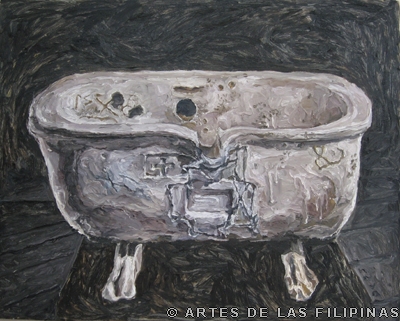
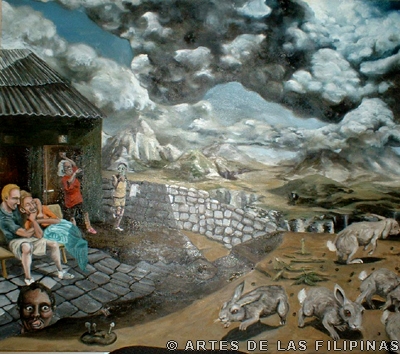
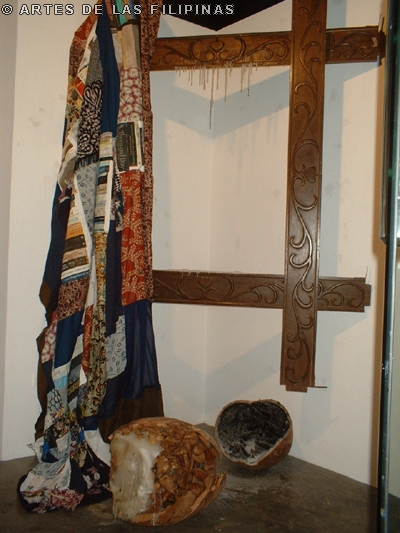
Elaine NaVas
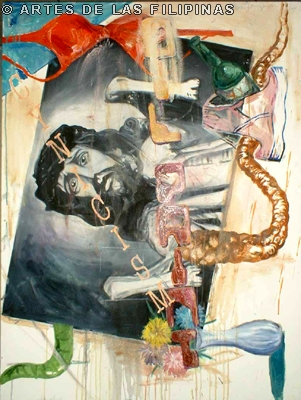
“Bathtub After A.T”
48 x 48 inches
2006
Oil on Canvas
We can’t go wrong then, we had the support of the big artists. We have their works to sell to stay on, make money and promote young artists.
We were consistent in putting up shows (sale or no sale) but also persistent and insistent on pushing the works. Most of our clients started with figurative works but with constant exposure they soon appreciated abstract art. We grew up together in Art. It was a challenge. When you have a gallery, you are actually selling your taste. The challenge was for people to also appreciate what you like.
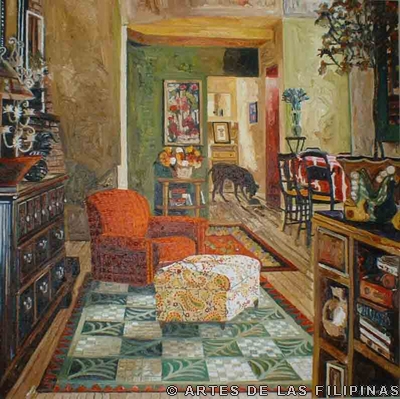
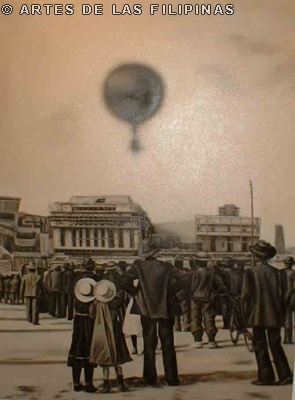
Francesca Enriquez
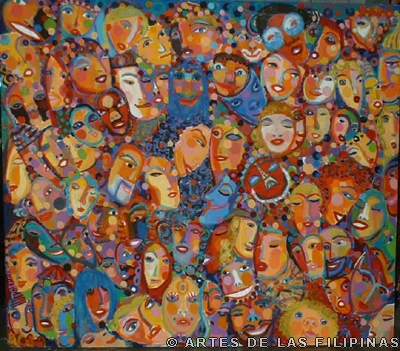
“My Pet Dog”
30 x 30 inches
2006
Oil on Canvas
The Big Names chose us, we chose the rest. Anyway, number one consideration is the Art itself. I look at art intuitively, I follow my own instinct for what is good. Number two is the artist. We choose an artist, who is a professional and not too full of himself. He must be sincere in his art. Honest. An artist who will protect the gallery as we protect him and his works. An artist who does not compete with the gallery and himself.
It is okay as long as he protects his price or value of his works. If an artist sells his work too low from his house, he is actually ruining himself. He is competing with the gallery. No use then to put works in a gallery. The gallery can’t sell his works. The buyer will prefer to go straight to him than buy from the gallery.
We had one case then. An artist had a one man show with us. We had clients who reserved some of the works. One client came back to tell us the artist was selling his works 30 to 50% lower from his house. How can we compete with that? We only get 30% commission. We called up our clients and told them we cant sell them the paintings. Advised them to wait for the end of the show and get them straight from the artist. (The day the show ended, we returned all his works and told him off.) True enough, they got them straight from the artist, much lower than the gallery’s selling price which the artist.himself quoted. We banned him and his works forever.
A lot of the artists are professional too. Most of the artists we carry are. They always protect the gallery. They give the same discounts as we do when a buyer goes straight to them. They even give us a commission if the client was referred by us.
There is no such thing as exclusivity in the Philippines. Sometimes, rather oftentimes, it hurts, but that’s the way it is. We cant stop the system. We work hard, we spend time and money, to promote and create a market for the works of an artist, but he can be all over.
It is oftentimes the case with younger artists. I don’t blame them though. We cant sell enough to financially support them fully. (Probably we cant sell enough because we have competition) We also have limited exhibition space/slots to give to all of them. So they are all over, taking a chance. To get more exposure too.
But there is such a thing as mutual respect and trust between an artist and the gallery. There is a good working relationship between the artist and the gallery. No contract but we protect and take care of each other. We had that with the late Mr. Ang Kiukok. We have it now with Manuel Ocampo, Romulo Galicano, Francesca Enriquez, Pardo de Leon, among others.
The older artists, the named ones, the established ones, are more secure. They have one or two galleries selling their works. They are more discerning in choosing their galleries too. We are lucky to have some of them in our gallery.
Loyalty would be great. Anyway, they should come out with really good works for us to exhibit and sell. We also have a responsibility to our clients- to show and sell them the best.
To be true to themselves, coming out with works they are happy with.
To be responsible, they should be able to deliver. Good works, good exhibition.
We organize exhibitions here, in the provinces, and abroad (Asia). We tried the Art Fairs. We ask writers and critics to write about their art. We send out press releases. We advertise. We talked a lot about them and their works with our clients. We let them meet the collectors. It is easier to appreciate an artist’s work if one knows what makes him tick.
We usually “discover” them from school exhibitions, artist run spaces, competitions, etc. And most of the time recommended by people we highly respect – Mr. Chabet, one of the people who made Finale what it is now; Gerry Tan, Nilo Ilarde, who are supportive of these young artists.
I don’t know about them being top of their class. Or having an award. I only see their resume when we are preparing for their show. If I like the work, I ask them to consign, and let us try to sell it. Or better still give we give them a show. Of course I am happy and proud when they have an award. It confirms my choice.
I believe in all the artists we carry. It is easier to sell an artwork if I have a conviction and liking for it.
Advantages- People traffic. Better exposure.
Disadvantages- Traffic. And when you are amidst “tiangge looking galleries”, it pulls you down, or probably pulls you up( because your shows stands out).
Art galleries are usually destination places. We can be located anywhere , real collectors come to see us.
Oh yes, I am friends with Silvana Diaz, Chichi Salas, Norma Liongoren, Rock Drilon, and Jun Villalon and some others. We consult and help each other.
Collectors, whatever their motivations in acquiring art, are friends of the gallery. They support us and the artists. We have a special relationship- the collector, the gallery, and the artist with the work of art as a vehicle or the mediator.
We guide young collectors in buying art (but they should make their own decision). With hard core collectors, we consult each other.
Not until we talk to him. We show him some works. From his choice, we will know his taste. From his talk, we will know if he is a collector or a speculator. A speculator is someone who buys artworks to sell in time and earn money from it.
We prefer to sell to a collector. Someone who passionately appreciates the artwork and must acquire it. The artist would prefer that too. An artist is happier if a buyer acquires his artwork primarily for its aesthetic value.
Yes. But for some it is 50%.
Some dealers or galleries buy outright from artists. Sometimes an artist, when in need, sells his work much much lower than his gallery price. The dealer either sells it at the supposed market price (earns more) or gives a big discount.
It is not healthy when artworks sells much much lower than the artist’s gallery price, it lowers the artist’s market price, hence the artworks’ value. A collector, more so a speculator will of course be happy if he knows what he bought is appreciating in value.
There was one instance when a rather known artist needed money and asked us to sell his paintings fast at much lower prices. We could not sell them . Clients don’t like to own a painting which lowers instead of appreciates in value as years go by.
Artworks of a late artist who priced his works high in the galleries, but sold them up to 70% less from his home, are so difficult to sell now. The buyers who bought from the galleries ( who can only give the standard 10-15% discount) were not happy
that the market value of the artwork they have is lower than their acquisition prices.
Does this happen to your gallery?
Majority of the paintings in the gallery are on consignment. The artists gets 60-70%, the gallery 30 – 40%. We try to keep the market prices consistent.. We are a “tawad society”, we give 10- 15% discount, usually taken out of our commission.
We return what we can’t sell after sometime because we have limited space. If we think we can’t sell them, we ask them to bring more works to change the stocks. It is a common industry practice.
Have you ever had any serious issues in the past that concerns your gallery?
No. We have always been professional in our way of dealing. Our buyers and the artists could attest to that.
How would you tell if an artwork is forged?
The painting will tell you. The painting itself is the signature or mark of an artist.
Which works are the fast to sell in your gallery?
Extremes. The Big names’ and the young artists’ works. Kiukoks sell well and easy if it is the right price. Prices vary now. It used to depend on size but now if it is a real beautiful one it can sell high. Bencabs (if we have one) sells fastest now (time frame). Prices vary too especially when it is from the secondary market as it is usually is. The secondary market prices Bencabs sell higher than Bencab prices them.. No harm here, getting higher in the market than getting lower is healthier for the artworks and the art market.
The young artists works are selling better now. Acceptance and appreciation of contemporary art by a new breed of collectors makes it so.
Has there been any instance that a Bencab work is forged?
I have seen one or so.
Why do you think that there is a good number of forged Kiukok works?
It is big money. They don’t sell them cheap.
Are all the works available in your gallery commissioned by you or the artists are free to sell what they finished?
They are mostly consigned and not commissioned. Yes the artists are free to sell when we returned them after sometime. Some artists though, give us a commission when they get to sell an artwork from their homes which they had shown at the gallery. That is being supportive of us.
Do you influence your artist on what to create?
Not at all.
How do you update yourself in the art scene?
I go and see different exhibitions. I read. I travel a lot, sometimes with the artists. I hang out with them and learn from them.
Young artists today are intelligent, witty and creative. They think differently. They are so attuned with the times. They are keen observers of what is happening around them. They express their experiences thru their art. Or even what they want to happen or how they want things to happen. They are daring. They experiment with their materials and techniques.
One show which made an impression on me was Lena Cobangbang’s “All that heaven allows” (Terrible Landscapes). She picked out pictures of disasters from magazines. She recreated a scene arranging food – vegetables, cake, etc., to look like the disaster. Then she took a picture of it. Looking at the picture is seeing a disaster scene- a vehicular accident, an earthquake, etc. until you realize you are seeing food. She expressed and presented her concept creatively with wit and intelligence.
How do artists make money out of conceptual art?
Conceptual art is motivated by an idea, not by an image, but it is mostly visual. It could be in painting, sculpture, installation, video, etc. They can definitely sell like any other artwork.
How would you describe a young collector?
A young collector is in the age of 18-40 years old. They lean towards the works of the artists of their generation. They are willing to learn, they do research, and are very selective in making their choices, usually buying within their means. They are prepared to be serious about what they are doing.
How would you describe a serious art collector?
A serious art collector is passionate. Has conviction, and willing to take risks. He has the eye for beauty. A true collector is in love with his art, he does not buy for investment ,and he does not sell. He is consistently buying. He is generous. He shares his collection to the public by lending out to exhibitions. He supports projects and publications. He gets firsthand choice in good works of art. He is trusted.
Are you indifferent with speculators?
I will be happier if they are not speculators. I am sure the artists will be too. It is always a good feeling to know that a beautiful work of art will go to somebody who really appreciates it, loves it and takes care of it.
Are there any other types of collector you have observed in your experience of dealing with them?
Have you ever exhibited and sold a work of an artist who did not continue his artistic career?
Yes, several. I exhibit and create a market for works of young artists which I like and believe in. But cant guarantee if he will continue being an artist or if his prices will appreciate. Collecting Contemporary Art as an investment can also be risky. One will never go wrong when he buys Art purely for its aesthetic value. He must like it, must have a passion for it, and can live with it. Art should be an investment in one’s happiness. Unfortunately, when he has to sell, it will not sell as high as works of others who chose to remain as artists.
What is the most important lesson you’ve learned in art dealing?
One has to be honest and straight in art dealing.
From the secondary market, I will only sell a painting I can vouch for. Vouch for its authenticity. I have to know the provenance, make sure its not a hot property.
From the primary market, I will only sell an artwork which I have a conviction for. I must also like it. It must be something I can resell in the future when it comes back to the gallery.
How do you get people to come and see every time the exhibits by various artists?
We send out press releases, notices, and invitations, text messages. We call.
Are all the works you exhibited sold out?
No. There are exhibits that don’t even sell a single work. Zero. We sell the works in time. We tell the artists to have lots of patience when they are starting.
What is your long term plan for your gallery?
No plan. I live by the day. I would like a bigger space though. I want one as big as the Art Center so we can put up significant, exciting exhibitions.
Is the 30-40% mark up standard to all galleries?
If someone walks through that door, could you actually tell his taste in what to buy?
How is your relationship with your buyers – the art collectors?
Are you friends with the other gallery owners?
What is your reason for getting a space in La O center? Do you intend to target a particular market with this location?
What are the advantages and disadvantages of situating your gallery in a mall?
Who are your favorite artists?
Do they have to come from those on top of the class? Or must have won certain awards?
How do you follow the careers of these young artists?
How else do you promote your artists?
What else?
What are the other responsibilities of an artist to a gallery?
How does exclusivity work between the artist and gallery owner?
How do you deal with artists who sell directly from their homes?
What standards do you follow in choosing which artist to exhibit or sell their works?
How were you able to sell the idea of buying abstract art to your customers?
How did the market accept your first attempt to sell?
Who were you selling back then?
What are some of the problems that you encountered when you were starting?
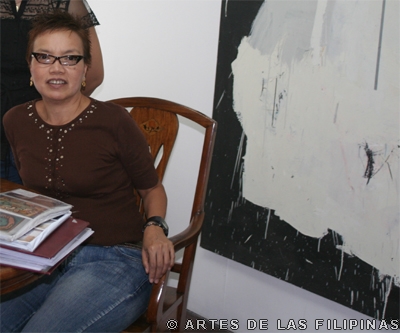
ART CONVERSATION WITH VITA SARENAS
OF FINALE ART GALLERY
by: Christiane de la Paz
One of the most respected and most experienced among gallery owners in the Philippines, Evita Sarenas has earned the reputation for launching the careers of many young and promising artists in the Philippines. She started specializing in the works of the Modern Masters in the early eighties and was the recognized gallery to sell Ang Kiukok’s works. Her sharp eye, perseverance, and passion have helped many connoisseurs develop a strategy and encourage a well-informed and sophisticated approach to acquisitions. In this interview, Evita Sarenas gives an insight of her early beginnings as a student of Fine Arts to stumbling a job of managing a gallery in 1983 and becoming the Philippines’ most sought gallery of modern and contemporary art.