Purveyor of Knowledge and Emerging Publisher of Content and Visually Driven Books

February 21, 2026

Lucian Freud Says Thank You to the Nation with a Corot Painting


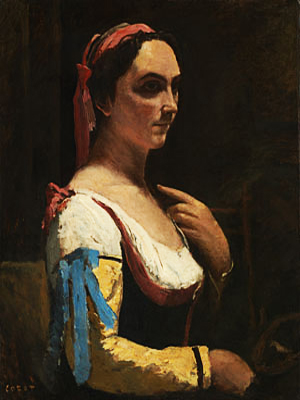
Jean-Baptiste-Camille Corot, L’Italienne ou La Femme à la Manche Jaune
(The Italian Woman, or Woman with Yellow Sleeve ), about 1870


Lucian Freud Says Thank You to the Nation with a Corot Painting


February 2013
–The late artist Lucian Freud has left a treasured painting by Jean-Baptiste Camille Corot as a thank you to Great Britain for welcoming his family when they arrived as refugees in 1933.


Jean-Baptiste-Camille Corot, L’Italienne ou La Femme à la Manche Jaune (The Italian Woman, or Woman with Yellow Sleeve ), about 1870

Freud’s Jewish family moved from Berlin to London to escape the rise of Nazism when he was 11. He became a British citizen in 1939 and went on to become one of last century’s finest painters before his death aged 88, in July 2011.

The Arts Council England have allocated the painting, L’Italienne ou La Femme à la Manche Jaune (The Italian Woman, or Woman with Yellow Sleeve), to the National Gallery under the Acceptance in Lieu scheme, which allows people to transfer works of art and important heritage objects into public ownership in lieu of inheritance tax. Freud specified in his will that he wanted the painting to have its new home in the National Gallery so it could be enjoyed by future generations.

Director of the National Gallery, Nicholas Penny said:

“This painting is a great addition to the National Gallery where, although we have a very strong collection of Corot’s works, we have no examples of a late figure painting of this kind. Its rough-hewn monumentality and abrupt transitions anticipate Picasso’s exercises in the classical manner and make it one of the most modern looking paintings in the Collection. Freud was a frequent visitor to the Gallery and had an exact idea of the impact that this bequest would make.”


About the painting

“L’Italienne ou La Femme à la Manche Jaune (The Italian Woman, or Woman with Yellow Sleeve)” was painted in Corot’s Paris studio and dates from the last years of his life. It depicts a distinctive looking woman, turning away and gazing into the distance. It is highly detailed and exquisite in its craftsmanship, offering a fantastic example of Corot’s later works.

 “L’Italienne” (about 1870) was bought by Lucian Freud at an auction in 2001, and then hung on the top floor of his London home. It hasn’t been shown in public since it was on display in the Louvre, Paris, in 1962.  

The portrait joins 20 paintings by Corot currently in the National Gallery’s collection, which range from a sketch made during his first trip to Italy to a ‘souvenir’ landscape of 1874. In addition to these the Gallery has the late, great decorative panels The Four Times of the Day on loan from the Loyd Collection.  

SOURCE: The National Gallery Website
 

HGallery Owner: Evita Sarenas of Finale Art Gallery
The most respected and most experienced among gallery owners in the Philippines, Evita Sarenas has earned the reputation for launching the careers of many young and promising artists in the Philippines. She s...
lee mas...
Munch's 'Scream' beats auction record at $119.9 mn
May 2012--"The Scream" is one of four versions of a work whose nightmarish central figure and lurid, swirling colors symbolized the existential angst and despair of the modern age. It was sold by Norwegian Petter Olsen, whose father was...
lee mas...
Modern Graffiti Artist: HEPE
February 2009--Graffiti is from the Italian word graffiato which means scratched. It has a long history that goes back to the figure drawings found in the walls of ancient ruins in  Rome and monuments in Egypt....
lee mas...
Lex Tuviera's Breezy Beach and Secret Gardens
Lex Tuviera’s Breezy Beach and Secret Gardens by: Christiane de la Paz September 2014–In 1978, Lex Tvbiera received his first commissioned work from Emmi Barbin, an ardent art collector based...
lee mas...
Antique "Santos" Are Much More Than Folk Art
March 2015--When the Spaniards arrived in the Philippines with sword and cross in hand some four centuries ago, they brought with them  the art of religious image-making. The first “santo” on Philippine soil was a...
lee mas...
angono0211
The Angono Petroglyph
The Angono Petroglyph by: Teta Limcangco     The Angono Petroglyph is a recent archeological breakthrough during the 80’s found in the mountainside of Angono and Binangonan by Carlo “Botong” Francisco....
lee mas...
Book Review: Philippine Ancestral Houses Fernando Zialcita and Martin Tinio
The two hundred and sixty-three pages of the coffee table book, Philippine Ancestral Houses, is a richly illustrated history and analysis of the bahay na bato - - how it came about, where, when, and how i...
lee mas...
federico
FEDERICO SIEVERT'S PORTRAITS OF HUMANISM
JUNE 2024 – Federico Sievert was known for his art steeped in social commentary. This concern runs through a body of work that depicts with dignity the burdens of society to offer a counter-narrative to demagogues and s...
lee mas...
The History of the Manila Cathedral
November 2011-- The year was 1521, as Ferdinand Magellan set foot in the Philippines, it marked the arrival of Catholicism in the Philippines. The Spanish colonization paved way for the spread of Christianity and the era...
lee mas...
Private Collections Art Book Launch
Originally written by   Carmelita Estrallado, Eddie Chua, David Consunji Charlie Cojuangco Patrick Reyno Ester Gabaldon, Ed Liao Artur Tanco and Manny Zialcita Eddie Chua, David Consunji Alexander...
lee mas...