Purveyor of Knowledge and Emerging Publisher of Content and Visually Driven Books

March 26, 2026

May 15 — The Pahiyas Festival of Lucban, Quezon

The Pahiyas festival transforms the small towns of Quezon province from ordinary to exquisite sight.

Photo courtesy of https://imagesphilippines.com (Nestor Santiago)


MAY 15 — THE PAHIYAS FESTIVAL OF LUCBAN, QUEZON

by Mailah Baldemor


The Season of Festivals is celebrated on the merry month of May. One extravagant festival that everyone is excited to see is the Pahiyas Festival in Quezon Province, which is celebrated on the 15th of May. Quezon, formerly known as Tayabas, is the second largest province in the Southern Tagalog region. The Pahiyas festival is simultaneously celebrated in the towns of Tayabas and Sariaya? Nevertheless, people go to Lucban because of its extravagant preparations which by tradition started during the 16th century as a way of thanksgiving for the people’s bountiful harvest. 


The Pahiyas festival transforms the small towns of Quezon province from ordinary to exquisite sight. Originally a pagan harvest festival, it is now commemorated in honor of San Isidro Labrador – the patron saint of farmers, peasants, laborers used to be a farmer in Madrid. According to legend, white oxen magically plowed his fields whenever he went to church. After being colonized by Spain, the legend was passed on to the Philippines. On the other hand, he was the venerated patron saint of agriculture in Mexico who was called upon by people to ensure the abundant supply of water and fertility of the land.


Pahiyas is a festival that takes a long time to prepare and celebrated only for a short period. One of the much anticipated sights to see is the colorful decoration of houses made from different fruits, vegetables, and kipings. The people of Quezon believed that the practice started when farmers offered foods at the foot of Mount Banahaw. The ritual changed over time and the food offerings was brought to the church. In the old times, farmers brought all their harvest to the church for blessing. They believed that this ritual was essential because they were told that failure to do so could bring deprivation, dearth and misfortune to the town. Later on, the farmers received more blessings and their harvests were bountiful. The Lucban church, known to be the oldest church in the town, soon became the place where the pahiyas festival was held.


The Pahiyas Festival is celebrated in honor of San Isidro Labrador, the patron saint of farmers

Photo courtesy of https://imagesphilippines.com (Nestor Santiago)


To keep the tradition alive, people agreed to display their harvest in front of their homes where the parish priest would come to bless the harvest during the procession of the image of San Isidro Labrador, the patron saint of farmers and in honor of the festival that is being celebrated.  Because of the economic situation, the town decided that every year only assigned houses around the town would participate by means of a competition, the best decorative and creative design of the Pahiyas during the festival. Houses used different fruits, vegetables, hats, baskets, paper-mache and kipings. After the competition, all the decorations will be thrown away to the people. But the important thing to prove that you have been to Lucban is seeing the colorful kipings and tasting the delicious Pancit habhab and longganisang Lucban. The pancit habhab is made from rice flour. These noodles were sold and served on a piece of banana leaf on the streets. It is eaten straight from the leaf, the habhab style. The longganisang Lucban is made of ground pork with fat, oregano extract, paprika, salt, pepper & garlic.
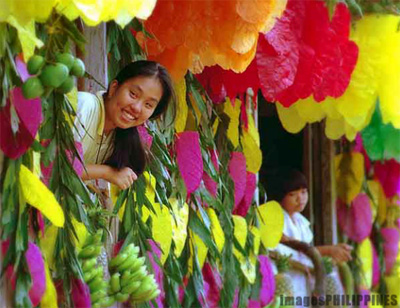


The houses in Lucban during the Pahiyas festival are decorated with fruits, vegetables, and kipings.  

Photo courtesy of https://imagesphilippines.com (Samuel Peralta)


Kiping is leaf-shaped wafers made of rice dyed in brilliant colors. The leaves used include the kabal, kape (brown coffee tree leaf), talisay (umbrella tree), kakaw (cocoa tree), and saba (cooking banana). Rice paste is used to create the kipings. They say, the procedure in making the kiping is a secret and only the chosen ones will be entrusted to make it.

So, get your best and favorite sneakers or rubber shoes, water bottles, cameras, video camera, hats, and umbrellas. Welcome to the Pahiyas Festival!

 

Jose Zabala Santos (1911-1985)
March 2013--Jose Zabala Santos or “Mang Pepe” to his neighbors in Kuatro Kantos, Malabon, was born in Calumpit, Bulacan on July 20, 1911. He acquired his early drawing skills from his mother whose avocation i...
lee mas...
An Exhibition of the Design Legacy of Salvacion Lim Higgins
September 2022 – The fashion exhibition of Salvacion Lim Higgins hogged the headline once again when a part of her body of work was presented to the general public. The display is chic, refreshing, modern, contempora...
lee mas...
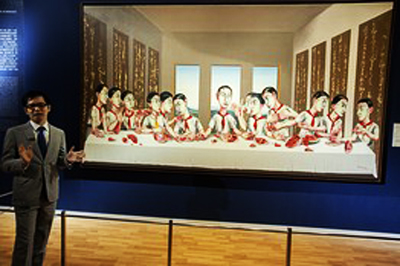
Zeng's Last Supper Sells for Record $23.3 Million at Sotheby's Auction
October 2013--A painting by Zeng Fanzhi sold for US$23.3 million at a Sotheby's auction on Saturday night in Hong Kong, setting a new record price for a work by an Asian contemporary artist.  Titled “The Last Su...
lee mas...
Federico Estrada: The Forgotten Great
October 2013-- A lesser known contemporary of Vicente Manansala, Federico Estrada started his career as a sculptor in 1932. He was the first Filipino to work at the atelier of Pietro Amberti who taught him the secrets of s...
lee mas...
Betis Mandukit: A Comparative Analysis of the Works of Wilfredo Layug and Boyet Flores
November 2015--When one mentions the district of Betis in the town of Guagua, Pampanga, the first thing that most likely comes to mind is woodcarving. It is an art that is as old as the history of the town itself and a sk...
lee mas...
Ambrocio Mijares Morales (1892-1974): Engraver, sculptor, art professor and supporter of the Katipunan
May 2014--Engraver, sculptor, art professor and supporter of the secret organization, the Kataas-taasan, Kagalang-galangang Katipunan ng mga Anak ng Bayan (KKK), Ambrocio Morales’s earliest recorded sculpture in 1927 was the bust of Bonifacio Bedaña (alias Suyod), the president of th...
lee mas...
Shouting in Bronze: The Lasting Relevance of Andres Bonifacio and His Monument in Caloocan
Amidst the concrete jungle in the middle of the city of Caloocan, amongst the smog of pollution, stands the dignified figure of Andres Bonifacionational hero, Founder of the Katipunan, Father of the Filip...
lee mas...
Lenore Lim's Liberation of Colors
November-December 2012--Lenore Lim burst upon the art scene in 1968 after graduating from the UP College of Fine Arts where she was a student of Jose Joya, Carlos Valino, Larry Alcala and Virginia Agbayani. To create her de...
lee mas...
Ginto A Golden Heritage From Our Filipino Ancestor
GINTO A GOLDEN HERITAGE FROM OUR FILIPINO ANCESTOR March 2016–This exhibit feature ancient ornaments crafted by our Filipino ancestor from 700 to 1,200 years ago. These form part of the Bangko Sentral...
lee mas...
The Quiapo and Pakil of Danny Dalena
December 2015--Danny Dalena appeared with a bang in the early seventies. He first made his mark with a brilliant and caustic political cartoons and illustrations for the Free Press Philippine Leader which gave new life t...
lee mas...