Purveyor of Knowledge and Emerging Publisher of Content and Visually Driven Books

January 18, 2026

The Higantes of Angono


Angono’s Higante Festival

Photo Courtesy of Wow Philippines: https://tourism.gov.ph


THE HIGANTES OF ANGONO

by: Mailah Baldemor


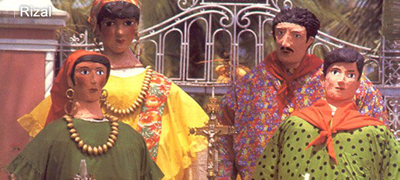
Have you ever seen giants? Do you have the slightest idea how they looked like? Our parents read to us fairy tale stories when we were young and occasionally see them in movie theaters. But to tell you the truth, I have seen the giants or the higantes. I never actually believed they existed in real life but I realized that they do when I came to visit a town in Angono. Let me tell you the story. It was a sunny afternoon when my family and I came across Balaw-Balaw, a gallery-restaurant that offers exotic foods for the adventurous diners. Owned by the late Lakeshore artist Perdigon Vocalan, this restaurant is becoming popular among foreign and local tourists alike. Diners can wander in the gallery while waiting for their food to be served. Upon entering the restaurant, you will see the “Mag-anak,”– the family of higantes that consist of the father, mother, and child, looking closely at the people passing by. 


As I remember, I asked him regarding the higantes. He told me about the annual festival of Angono — the Higante Festival in honor of St. Clement, the patron saint of the fishermen. This festival is celebrated on the 23rd of November. The higantes are made of paper-mache. In Mexico, paper- mache is called piñata while our native town in Paete, Laguna calls it taka. Higantes measures four to five feet in diameter and ten to twelve feet in height. Traditionally, it began in the last century when Angono was a Spanish hacienda. This higantes was influenced by the Mexican art form of paper-mache brought by the Spanish priests to the Philippines. They are created larger-than-life caricature of their Spanish landlords. Another story was that of the Frenchman who happened to pass-by the town of Laguna de Bay as he cruised from ManilaBay. The town of Angono being divided by river fascinated him. He predicted that someday giants would emerge and the town will be renowned. It happened as the Frenchman predicted. Angono produced two National Artists — Carlos “Botong” Francisco in the field of visual arts; and Professor Lucio de San Pedro in the field of music.
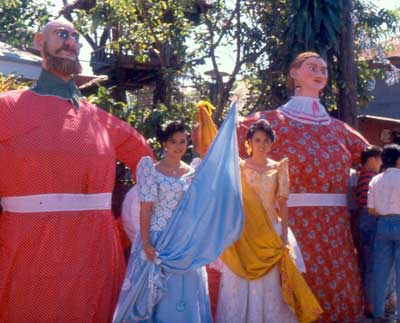


Higante’s costume and its inner body is made of bamboo,
rattan and thin iron bars

Photo Courtesy of Wow Philippines: https://tourism.gov.ph
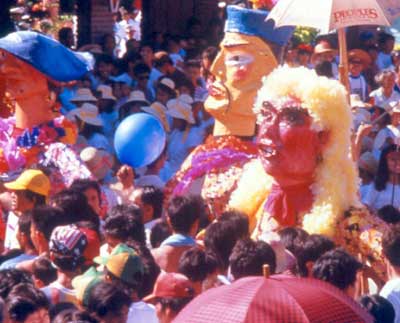


Heads of higantes are fashioned from a mold made of clay then dried
under the the sun
Photo Courtesy of Wow
Philippines: https://tourism.gov.ph


These higantes were paraded in the town. Two men help each higante walk by controlling it from inside throughout the entire event. The head has two holes for each man to see through. Additional holes are also made on the higante’s clothing to help the two men see beneath. Children are usually afraid of the two higantes (father and mother) but they are fond of the child. These higantes danced, walked, turned, and ran. According to the book entitled Angono Rizal: Art Capital ng Pilipinas by Ligaya G. Tiamson Rubin. It was stated that Karias Tangkad was the one who made the first higante. Perdigon conceived the idea of having a Higante Festival. The thirteen barangays of Angono are represented by higantes symbolizing their personality and industry. With this idea they where given funding by the Department of Tourism and the Provincial Tourism Office. It was really a good start because the following year as seminars and workshop for higante making took place and a competition was put up to award the best higante made. The higante designs developed as time went on.  The higantes became a part of Angono. And the story lives on.


What are these higantes made of? Do they eat small, naughty children? Do they have the goose that lays golden eggs and the singing harp as told from the story of Jack and the Beanstalk? No, they are different higantes. They are made of paper. Giant heads are fashioned from the mold made of clay, which is dried under the sun’s blazing heat. With the rapid growth of modernization and technology clay changed to plaster of Paris and resin. The mold is pasted with lots of newspapers then split into the middle and sun-dried, after which it is then again pasted with the brown paper or Manila paper then split into the middle and sun-dried. The outside body is painted with different designs or dressed with yards of yards of clothing materials and accessories to complete their costume and the inner body is made of bamboo, rattan and thin iron bars.


Josie Lim Cruz's Vital Gestures
February 2012--Well-regarded by critics, artists, collectors and art students, Josie Lim Cruz began her artistic career in Manila during the mid-1980s but emigrated to America in 1995, where she continues to paint, teach, co...
lee mas...
Art Collector Reggie Quimbo
I interviewed Reggie Quimbo over the phone a few days before this conversation. When we met in his residence, he took me to the two-floored space, which serves both as his familys ancestral house and his d...
lee mas...
The History and the 1930s Graduates of the University of the Philippines School of Fine Arts
February-March 2014--The School of Fine Arts was established by authority of Act No. 1870, founding the University of the Philippines which was enacted by the Philippine Assembly on June 18, 1908. The School was opened to...
lee mas...
New Biography Says van Gogh Did Not Kill Himself
October 2011-- A new biography of Vincent van Gogh and a “60 Minutes” report on it scheduled for Sunday night call into question the long-accepted notion — central to the myth of the troubled artist &mda...
lee mas...
Zeng's Last Supper Sells for Record $23.3 Million at Sotheby's Auction
October 2013--A painting by Zeng Fanzhi sold for US$23.3 million at a Sotheby's auction on Saturday night in Hong Kong, setting a new record price for a work by an Asian contemporary artist.  Titled “The Last Su...
lee mas...
Edrick Daniel's Chimerical Pursuits
August 2012--Edrick Daniel began his career in 2004 painting figurative works that show the influence of surrealism. Fantasy, tales, relationship informed his early narratives. Later, he sought the foundation of a figurativ...
lee mas...
Lex Tvbiera's Breezy Beach and Secret Gardens
September 2014--In 1978, Lex Tvbiera received his first commissioned work from Emmi Barbin, an ardent art collector based in Missouri, U.S.A to paint the American jazz musician, John Coltrane. Signing Tvbiera as his artist...
lee mas...
Art Collector Patrick Syling
Patrick Syling was never taught to appreciate art as a young boy. As a Chinese-Filipino growing in the busy town of Binondo, he was trained early on to help in the family business and art was not something you w...
lee mas...
Marcel Belleza Antonio: The Son, The Man, The Painter (First of Two parts)
The works of Marcel Antonio belong to an expressive and non-literary tradition of storytelling. He began his career in 1983 while still a sophomore at the University of the Philippines College of Fine Arts....
lee mas...
Shouting in Bronze: The Lasting Relevance of Andres Bonifacio and His Monument in Caloocan
Amidst the concrete jungle in the middle of the city of Caloocan, amongst the smog of pollution, stands the dignified figure of Andres Bonifacionational hero, Founder of the Katipunan, Father of the Filip...
lee mas...