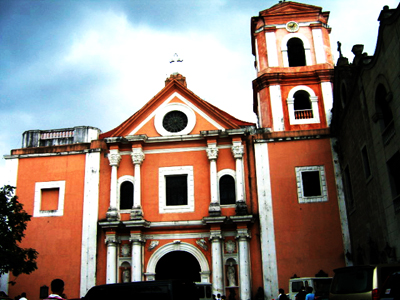
The Facade of the San Agustin Church
Image Source: commons.wikimedia.org
The History of the San Agustin Church
by: Jericho Paul C. Santos
January 2012– Along with its search for wealth, the Spanish colonizers made it a top mission to spread Catholicism in the Philippines. And to broaden the reach of Christianity, a place for worship is needed to bring the congregation together. As a result, churches were built around the country for Christianity to thrive. One of these churches was the San Agustin Church.
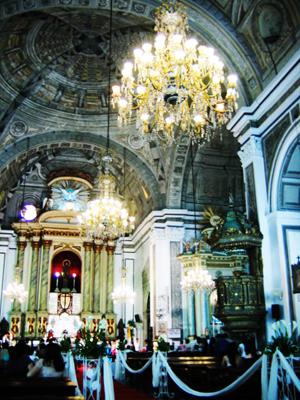
The Interior of the San Agustin Church
Image Source: commons.wikimedia.org
The San Agustin church was rebuilt three times due to man-made and natural disasters. Since then, it has withstood natural disasters and has become the oldest church in the Philippines. It is now recognized by the government and UNESCO as a historical landmark.
The History of the Church
The San Agustin Church was under the auspices of the Agustinian Order. The friars took the cudgels in building the church. Like many structures during that time, the church of San Agustin was built with the use of nipa and bamboo. The building of the church started in 1571, it was then officially named as Iglesia y Convento de San Pablo.
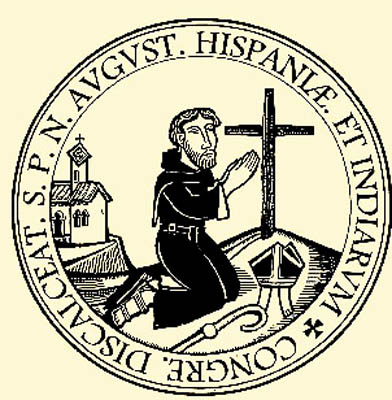
The Augustinian Friars
Image Source: commons.wikimedia.org
In 1574, the Chinese pirate, Limahong invaded Manila. The invasion led to the burning of the city and the San Agustin Church was not spared. This led to the first reconstruction of the church a year later. The second church was made of wooden materials. Because of the choice of the structural material used, it remained risky to fire accidents. True enough, another fire caused the destruction of the church in 1583.
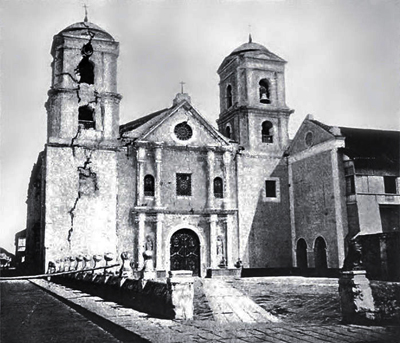
The damaged Bell Tower
Image Source: commons.wikimedia.org
The Augustinian friars made sure not to commit the same mistakes and so they decided to build the new church using adobe stones. In 1586, they appointed Juan Macias to lead the design and construction of the church. It was only in 1607 that the declaration of its official completion was made. The structure endured even on the strongest earthquake that hit Manila from the 16th to 17th century. The only major damaged that the San Agustin endured was the collapse of one of the church’s bell tower, which was then permanently removed therafter.
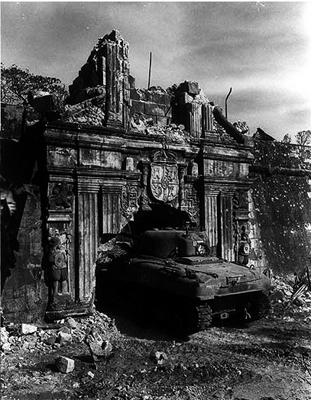
The Battle of Manila Bay
Image Source: commons.wikimedia.org
Because of the church’s age, it has become a witness to many significant events in Philippine history during the Spanish period. In 1762, during the Seven Year’s War, British forces looted the church. In 1898, the church became a venue for American and Spaniards to discuss and sign the surrender of Manila to the Americans.
During the Second World War, the Japanese forces turned the San Agustin Church into a concentration camp for prisoners. As the Battle of Manila in 1945 draw to close, the Japanese held hostage priests and hundreds of residents inside the church. To drive out the remaining Japanese, American and Filipino forces conducted an air raid inside Intramuros. The bombardment led to the death of several civilians. After the shelling of Intramuros, structures in the walled city was reduced to rubbles but the San Agustin Church remained one of the standing churches after the war.
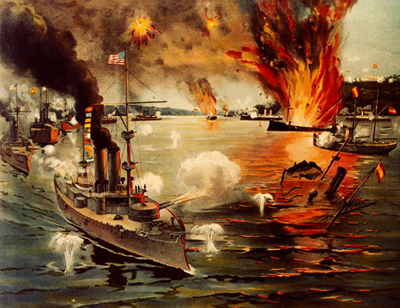
The Battle of Manila in 1945
Image Source: commons.wikimedia.org
In 1945, the San Agustin Church became the seat of the Immaculate Conception Parish. The archbishop of Manila requested for the transfer of the seat of parish from the Cathedral to the San Agustin Church. After the war, the church also became the host of the first Philippine Plenary Council. In 1976, the government recognized the church as a National Historical Landmark for its contribution to the country’s nationhood. The Republic Act No. 10066 or National Cultural Heritage act of 2009 tasked the National Center for Culture and the Arts to conserve the church.
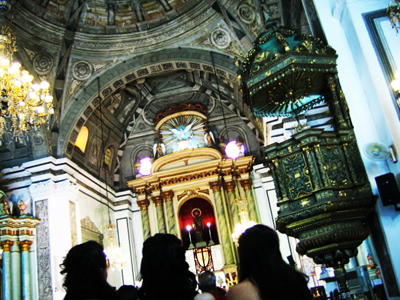
The Renovated San Agustin Church
Image Source: commons.wikimedia.org
In 1993, the San Agustin Church was named by UNESCO as a World Heritage Site. Other Philippine churches included were the Nuestra Señora de la Asuncion in Ilocus Sur, the San Agustin Church in Ilocos Norte and the Santo Tomas de Villanueva Church in Iloilo. These Spanish era churches were classified under Baroque Churches of the Philippines.
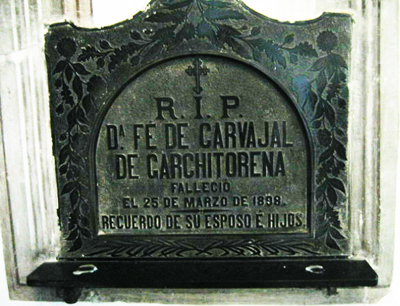
The San Agustin Museum
Image Source: commons.wikimedia.org
Today, the church remains a charm of the Walled City of Intramuros. It is also home to the tomb of the first governor-general Miguel Lopez de Legazpi and other Spanish conquistadors including Juan de Salcedo and Martin de Goiti. Its façade is massive like those found in Ilocos churches but San Agustin’s facade appears lighter because of its ornamentation and elaborate curves. The ornate interior is filled with intricate trompe l’oeil frescoes. Notwithstanding, the San Agustin Museum is home to a collection of Spanish era artifacts, furniture, paintings, statues and other church ornaments.
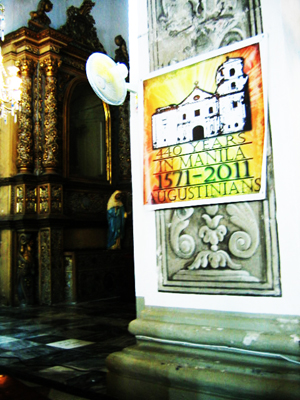
The San Agustin Church
Image Source: commons.wikimedia.org
San Agustin church has been one of the premier churches during the Spanish period. It served as the source of the political influence of the Spanish colonial rule in the Philippines. Today, its contribution to nationhood will forever be embedded in the history of our country.
REFERENCES
“About San Agustin.” San Agustin Church Official Website, 2011. Web. 4 Nov. 2011.
Chan, Peter. Christianities in Asia. United Kingdom: John Wiley and Sons Ltd. 2011.