Purveyor of Knowledge and Emerging Publisher of Content and Visually Driven Books

February 16, 2026

The Long Tradition of Hand Embroidery in Taal, Batangas


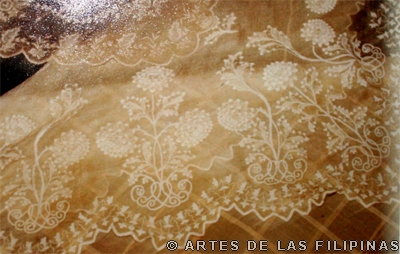
A nineteenth century piÑa cloth with embroidered edges, believed
to be the property of the Yriarte family of Manila.
Photo Courtesy of Teresa de Vera from Casa Manila

THE LONG TRADITION OF HAND EMBROIDERY IN TAAL, BATANGAS
by: Christiane de la Paz

The town of Taal, Batangas had a long tradition of hand embroidery since the turn of the century. Its intricate, well-embossed hand embroidery made it increasingly a refined art of society. It boasts of its highly callado (a kind of filigree work wherein yarn in painstakingly pulled off from the cloth) as one of the finest in the world.

Pina and jusi are the traditional fabrics used by the bordadoras. Pina is a soft, fine, flexible, and durable off-white fabric about two to four inches in length. It is derived from the finest mature leaves of the red Spanish variety of pineapple. During the Spanish period, pina was the most expensive and highly sought fabric worn for barong Tagalog by the illustrados on very rare special occasions It is a very delicate material, too difficult and expensive to embroider. Jusi (the Chinese term for raw silk), on the other hand, is a lightweight, flimsy, and ecru colored fabric regarded by the bordadoras as the best material for embroidery. 
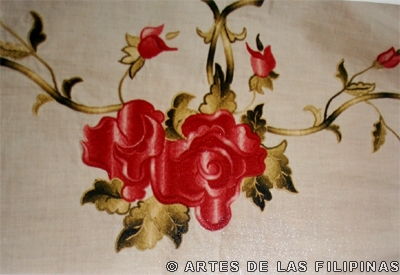

The vanishing thread (eskaladao) as shown in the flower motif.
Photo Courtesey of  Teresa De Vera (1989)

In Taal, hand embroideries are characterized by the following: makinis (smooth and even quality of the embroidery stitches), sunod ang korte, pino (fine) at masinsin, hindi makarat ang dibuho (design should be composed of fine, delicate shapes that are not scattered all over the cloth), mabintog (embossed quality of the embroidery which gives depth and volume to the design), matibay (durable), hindi hiris ang panahi, and magkakahawig na kulay. The makinis is the most important criterion of beauty in embroidery.

Hand embroidery starts with a magdidibuho (designer) who is in charge of stamping designs on the cloth. The cloth is then passed on to the magbuburda (embroiderer) who embroiders the cloth which the designer has stamped. The magkakalado works on the cut-openwork portion of the embroidery. There are three persons assisting the magkakalado: the magbabakbak, maglalala, and the magmumunggo. The magbabakbak draws the thread out from the cloth. The maglalala draws together the thread left in the process of pagbabakbak by applying various embroidery stitches on the cloth. The magmumunggo embroiders the part where thread was drawn together. These three functions can sometimes be done by a single person.
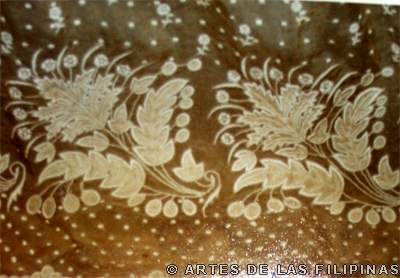
From the calado (open-work design), the cloth is brought to the magaagohero, in charge of embroidering the hem or edges of the embroidered cloth after which the maglalaba washes the embroidered cloth. The cloth then is mounted on a wooden frame to dry under the sun. Once dried, the cloth is folded and delivered to the cabecilla to sell.

During the early 1900s, naguas or lagwas (undergarments) and kamison (chemise) were the very first items to be embroidered. The intricate embroidery and callado are found in the bodice and hemline. Panuelo made of pina cloth have cut-open work and floral design on its edges. The leaves and flowers motif was the dominant design imprinted on cloth.

References:

Tagle, Mary, The Fine Art of Philippine Embroidery, Mobilways, 1961.

De Vera, Teresa, A Comparative Study of Traditional and Modern Modes of Embroidery in Batangas and Bulacan, 1989.
The Quiapo and Pakil of Danny Dalena
December 2015--Danny Dalena appeared with a bang in the early seventies. He first made his mark with a brilliant and caustic political cartoons and illustrations for the Free Press Philippine Leader which gave new life t...
lee mas...
Porfirio Castañeda on His Tatay, Dominador Castañeda
March 2016--Dominador Castañeda spent his early education at the Escuela de Bellas Artes in Quiapo, Manila. In 1924, he graduated at the University of the Philippines School of Fine Arts (UP SFA) and continued his...
lee mas...
Keiye Miranda's Moving Waters
September- October 2010-- Keiye Miranda has burst upon the art scene in 1998 roaming freely among photography, gallery assisting, art teaching and painting. But despite her  various activities in this period, she immersed...
lee mas...
Antiques Roadshow portrait revealed to be by Anthony Van Dyck
December 2013-- Father Jamie MacLeod, who runs a retreat house in north Derbyshire, first took the artwork to Newstead Abbey, Nottinghamshire, in 2012.  He said he was now planning to sell the piece by the 17th Century...
lee mas...
Book Review: Edifice Complex: Power, Myth, and the Marcos State Architecture by Gerard Lico
The book is about Marcosian Architecture. The author started each chapter with quotes from different scholars as an introduction to his discussions. The book is very much influenced by Michel Foucaults disco...
lee mas...
Raul Piedra's Textured Abstracts
June 2016--Known for his textured abstract paintings, Raul Piedra, still a college student in 1970, staged his first solo exhibition at the University of the East where he featured his paintings of botanicals, landscapes...
lee mas...
The Long Tradition of Hand Embroidery in Taal, Batangas
The town of Taal, Batangas had a long tradition of hand embroidery since the turn of the century. Its intricate, well-embossed hand embroidery made it increasingly a refined art of society. It boasts of...
lee mas...
Silay’s Ancestral Houses: The Glory of the Past
January 2013--A physical structure has no significance to the community if it does not have corresponding stories that help shape the people surrounding it. This reason has contributed to the preservation of family structure...
lee mas...
Lito Mayo's Alternate Reality
January-February 2017—Lito Mayo was a fixture in the Philippine art scene since the 1970s and his relevance in the history of Philippine art has never been questioned and ignored. When he was a college sophomore, he rec...
lee mas...
Daniel de la Cruz's Touchstone of Modern Sculpture
January-February 2011 -- Many of the artists who emerged in 2006 found themselves pursuing a career in painting. But Daniel de la Cruz, who turned forty that year, actively turned his thoughts towards his dream of becoming...
lee mas...