Image Source: commons.wikimedia.org
The History of the Manila Cathedral
by: Jericho Paul C. Santos
November 2011–The year was 1521, as Ferdinand Magellan set foot in the Philippines, it marked the arrival of Catholicism in the Philippines. The Spanish colonization paved way for the spread of Christianity and the era of Western church architecture in the Philippines. During the three centuries of colonization, it produced grandly design churches; one of these is the Manila Cathedral.
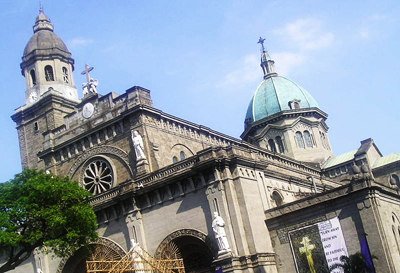
The present Manila Cathedral, situated at the heart of the walled city of Intramuros has gone several major reconstructions since its inception. The Neo-Romanesque-Byzantine cathedral has long been the seat of archbishop in the Philippines. And it continuous to be one of the most admired churches in the country.

Image Source: commons.wikimedia.org
The Seat of Spain’s Ecclesiastical Rule
The Manila Cathedral of today features Romanesque facade and beautiful cupola but its humble beginning is a far cry from when it was first built.
Mandated with the mission of the sword and the cross, Miguel Lopez de Legaspi, occupied Manila in 1571. Then the Spanish conquistador assigned an area for his new settlement for a church. The cathedral was known as Church of Our Lady of the Immaculate under the patronage of the La Purisima Immaculada Conception.

La Purisima Immaculada Conception
Image Source: commons.wikimedia.org
The church was made of the common structural materials of that time. The main materials used are nipa, wood and bamboo. The fire that razed the city in 1583 prompted the first reconstruction of the church.
The second cathedral was erected using stone as its main structure. It was an arduous task to complete the stone church. And in a country where natural calamities are common all year round, the cathedral was again hit hard by disasters. Earthquakes and strong typhoons lead to the devastation of the cathedral.
In 1614, the new stone cathedral was built. The architectural design consists of naves, chapels and altars. Another earthquake toppled the church in 1645 and left everything in ruins.
Introduction of Different Architectural Design
During 1681-1863, the cathedral repeatedly rose from ruins only to pick itself up again from the rubbles. On the architectural perspective it gave opportunity to introduce a new style in every restoration that has been made.
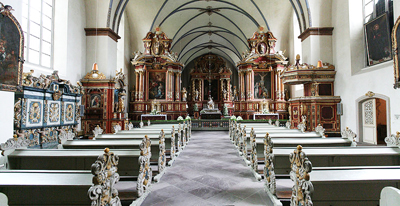
Image Source: commons.wikimedia.org
From an ordinary stoned cathedral rose a cathedral design contained with numerous altars and chapels. It had an imposing bell tower with a clock on the top. Inside the church are stained glass, molave woodwork and marble pavings. Ornaments, decorations and religious relics were either sourced from dignitaries, not to mention the poor citizens of the city who donated their precious pesos to maintain the high upkeep of the majestic cathedral.
In 1751, architect Juan de Uguccioni led the reconstruction of the cathedral into a baroques inspired architecture. However the 1852 earthquake destroyed parts of the cathedral and structurally weakened the other parts. The danger of a possible collapse is imminent therefore another reconstruction was made.
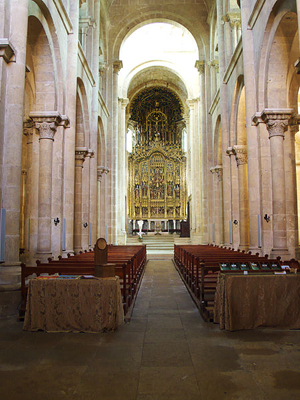
Image Source: commons.wikimedia.org
In 1858, it marked the completion of the restoration of the cathedral. This time the architectural design under Nicolas Valdes used the Neoclassic design. Then again in 1863, just like a cycle another earthquake struck and destroyed the church, the tragic event claimed lives to those inside the cathedral.
In 1879, Don Vicente Serrano y Salaverri employed the Romanesque-Byzantine style to the cathedral. His design has endured and has been adopted by the present cathedral. The interior was richly decorated, naves are spacious, the dome was raised on a fenestrated drum, and the arches are beautifully ornamented.
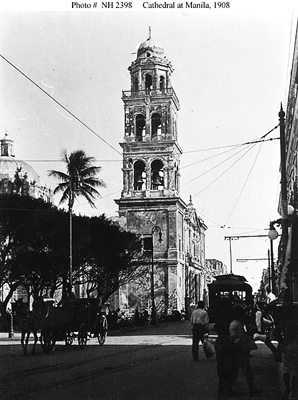
Image Source: commons.wikimedia.org
The cathedral’s last major restoration came after the ashes of World War II. In 1958, architect Fernando Ocampo was inspired by Serrano’s design but added more to its previous appearance to make it more functional to space. His Neo-Romanesque design is a combination of revival, renaissance and modern styles. The present cathedral is a product of the old cathedral’s great design mixed with Ocampo’s architectural touch.
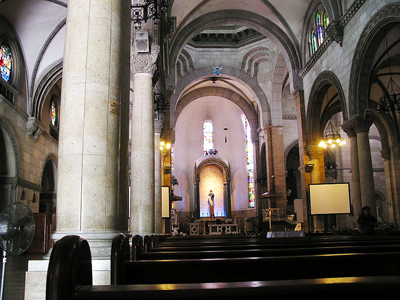
Image Source: commons.wikimedia.org
The Manila Cathedral experienced a lot of looks in more than three centuries of cycle of rising and falling. More importantly, it has witness history unfold in its surroundings. And more than just a structure, it has interwoven itself in the history of our country. The various challenges that it has endured showed that in the face of adversity one can rise to
REFERENCES
Boyer, Robert. Sundays in Manila. Quezon City: University of the Philippine Press, 2010
Bloom, Greg. Lonely Planet Philippines. Amsterdam: Lonely Planet 2009
Madale, Nasagura. “A Look at Philippine Mosques.” National Commission for Culture and the Arts, 6 Oct. 2003. Web. 18 Oct. 2011