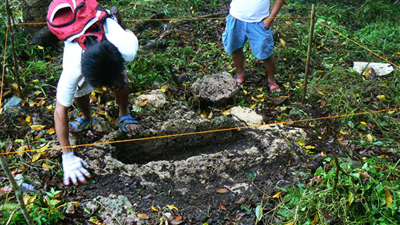
In this March 1, 2011 photo released by the Philippine National Museum,
Filipino archeologist clean the area around a limestone coffin at Mount Kamhantik,
near Mulanay town in Quezon province. Government archeologist have unearthed
remnants of what they believe is a 1,000-year-old village on a jungle-covered mountaintop in the Philippines with limestone coffins of a type never before found in this Southeast Asian nation, officials said Thursday. AP PHOTO
Unique Tombs found in the Philippines
Associated Press
MANILA, Philippines — Archaeologists have unearthed remnants of what they believe is a 1,000-year-old village on a jungle-covered mountaintop in the Philippines with limestone coffins of a type never before found in this Southeast Asian nation, officials said Thursday.
National Museum official Eusebio Dizon said the village on Mount Kamhantik, near Mulanay town in Quezon province, could be at least 1,000 years old based on U.S. carbon dating tests done on a human tooth found in one of 15 limestone graves he and other archaeologists have dug out since last year.
The discovery of the rectangular tombs, which were carved into limestone outcrops jutting from the forest ground, is important because it is the first indication that Filipinos at that time practiced a more advanced burial ritual than previously thought and that they used metal tools to carve the coffins.
Past archaeological discoveries have shown Filipinos of that era used wooden coffins in the country’s mountainous north and earthen coffins and jars elsewhere, according to Dizon, who has done extensive archaeological work and studies in the Philippines and 27 other countries over the past 35 years.
Aside from the tombs, archaeologists have found thousands of shards of earthen jars, metal objects and bone fragments of humans, monkeys, wild pigs and other animals in the tombs. The limestone outcrops had round holes where wooden posts of houses or sheds may have once stood, Dizon told The Associated Press in an exclusive interview.
The tombs were similar to ancient sarcophagus, which have become popular tourist attractions in Egypt and Europe, although the ones found in Mulanay were simple box-like limestone coffins without mythological or elaborate human images on the tops and sides.
Archaeologists have only worked on a small portion of a five-hectare (12-acre) forest area, where Mulanay officials said more artifacts and limestone coffins could be buried.
A preliminary National Museum report said its top archaeologists found “a complex archaeological site with both habitation and burial remains from the period of approximately 10th to the 14th century … the first of its kind in the Philippines having carved limestone tombs.”
The discovery has been welcomed with excitement in Mulanay, a sleepy coastal town of 50,000 people in an impoverished mountainous region that until recently was best known as a major battleground between army troops and Marxist rebels.
“Before, if you mention this region, people will say ‘Oh, that’s NPA country,’” Mulanay Mayor Joselito Ojeda said, referring to the New People’s Army rebels. “But that era is past and now we can erase that image and this archaeological site will be a big help.”
Mulanay tourism officer Sanny Cortez said that after archaeologists have finished their work in a few years, his town plans to turn Mount Kamhantik’s peak into an archaeological and ecotourism park. A museum would also be built nearby.
Despite the loss of thick tree covers in the 1,300-foot (396-meter) mountain’s foothills as villagers clear the jungle for homes and farms, the forested mountain still harbors a rich wildlife, including rare hornbills, wild cats and huge numbers of cave bats, including a white one recently seen by environmental officials. The mountaintop offers a scenic view of Tayabas Bay and the peak of Mayon volcano, famous for its near-perfect cone, Ojeda said.
The archaeological site is part of 280 hectares (692 acres) of forest land that was declared a government-protected area in 1998 to keep away treasure hunters and slash-and-burn farmers. Treasure hunters looking for gold exposed some of the limestone tombs years ago, but it was only last year that Manila-based archaeologists started to unearth the graves and artifacts and realize the significance of the find.
Treasure hunting has damaged many archaeological sites in the country. In the early 1990s, Filipino archaeologists led by Dizon discovered that 2,000-year-old burial jars with unique human face designs had been destroyed by treasure hunters in a cave in Maitum town in southern Sarangani province.
Archaeologists worked for a few years to glue the sack loads of clay shards piece by piece and restored more than 150 ancient burial jars to shape. Some of the Maitum jars are displayed at the National Museum in Manila with a plan to exhibit them in France next year, Dizon said.
SOURCE: Philippine Daily Inquirer
SOURCE: Philippine Daily Inquirer