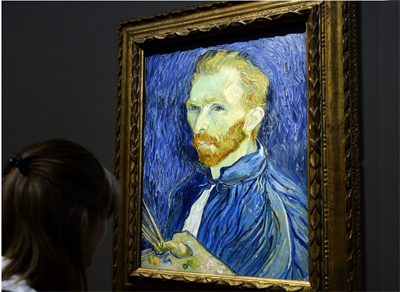
Forensics expert Dr. Di Maio supported a theory put forth in a 2011 biography
Van Gogh was murdered, claims forensic expert: “He did not shoot himself”
by: Antonia Mollay of The Independent
November 2014— The true nature of Vincent van Gogh’s death continues to be a topic ripe for mystery – after a leading forensics expert has claimed that the artist was murdered.
The Sunflowers painter died an agonising 29 hours after taking a bullet to the abdomen in a wheat field near Paris in 1890. On his death bed he apparently revealed he had shot himself.
However, Dr. Vincent Di Maio, an expert on gunshot injuries, has said that he be believes the wound was “not self-inflicted”.
According to Vanity Fair, Di Maio, who was a key witness at the George Zimmerman trial, said that it was highly likely that Van Gogh “did not shoot himself”.
He made the claim in response to a request by Steven Naifeh and Gregory White Smith, whose biography of Van Gogh disputes the long-held suicide theory.
In Van Gogh: The Life, a 960-page book published in 2011, the Pulitzer Prize-winning authors claim that the artist had been shot, possibly accidentally, by a couple of boys and that he had decided to protect them by accepting the blame.
American academic John Rewald had talked of hearing local rumours about such a theory in the 1930s.
But Naifeh and Smith were attacked for publishing their theory and in 2013 Louis van Tilborgh and Teio Meedendorp published a critical review in the Burlington Magazine, which reiterated the suicide narrative.
Following this, Naifeh and Smith asked Di Maio to compare the two accounts and put forth his opinion.
Van Tilborgh and Meedendorp wrote that the son of the attendant physician at Van Gogh’s death bed, Paul Junior, said Van Gogh’s wound had a “brown and purple halo around [it].”
According to the authors, this meant “the gun must have been fired at very close range … and was caused by the bullet’s impact.”
But Di Maio said: “In fact, [the purple halo] is subcutaneous bleeding from vessels cut by the bullet and is usually seen in individuals who live awhile.
“Its presence or absence means nothing.”
Meanwhile, he said the brown ring is “an abrasion ring and seen around virtually all entrance wounds”.
Di Maio also said that if Van Gogh did shoot himself there would have been “soot, powder tattooing and searing of the skin around the entrance”.
He said: “These would have been grossly evident. None of this is described [in any of the forensic accounts]. This indicates the muzzle was more than a foot or two away (closer to two rather than one).”
In conclusion he said: “It is my opinion that, in all medical probability, the wound incurred by Van Gogh was not self-inflicted. In other words, he did not shoot himself.”
However, it may take more than Di Maio to sway academic opinion.
A curator at the Van Gogh Museum told Naifeh and Smith in an email. “I think it would be like Vincent to protect the boys and take the ‘accident’ as an unexpected way out of his burdened life.
“But I think the biggest problem you’ll find after publishing your theory is that the suicide is more or less printed in the brains of past and present generations and has become a sort of self-evident truth. Vincent’s suicide has become the grand finale of the story of the martyr for art, it’s his crown of thorns.”
SOURCE: The Independent