Guillermo Estrella Tolentino: A Classic of His Time
by: Lilimay Manalo-Castor
“It is beyond doubt that Professor Tolentino is the first and last master in the representation of the human form in the Philippines.” — Napoleon V. Abueva
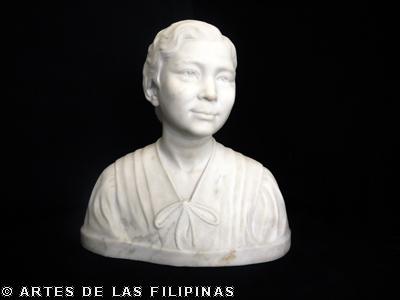
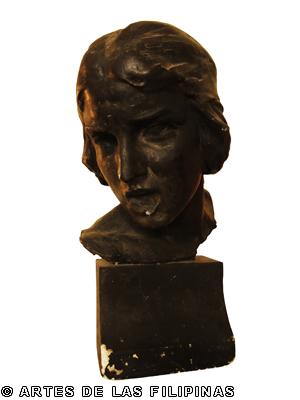
The Lady (Teodora Valenzuela Tiglao)
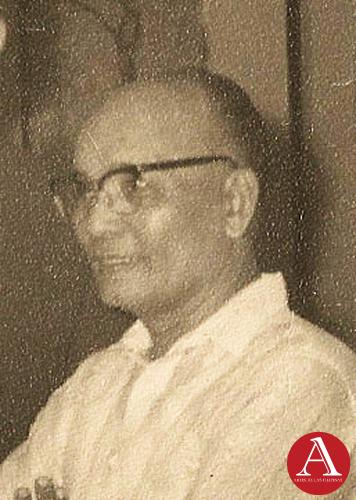
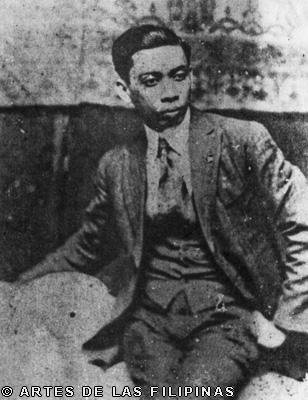
Guillermo Estrella Tolentino was born in Malolos, Bulacan on 24 July 1890. He was the fourth of eight children. His father was a tailor, whose only artistic trait is the love of playing the guitar. Guillermo or Memong, as his family called him, inherited this artistic skill. Moreover, Memong became one of the three best guitar players in the Philippines during his time.
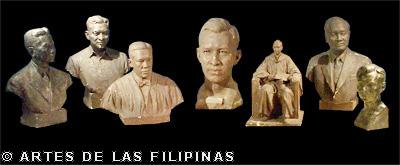
Pasig City Museum
Before his formal schooling, he used to mold horses and dogs in clay, out of the materials from the banks of the fishponds in town. He studied at the Malolos Intermediate School. From fifth to sixth grade, his teacher was Mrs. H.A. Bordner who also gave him his first instructions in drawing.
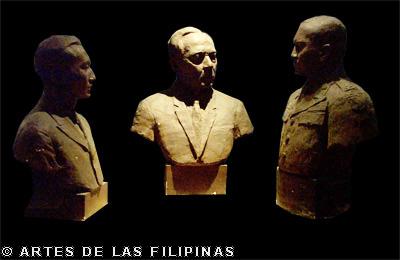
Pasig City Museum
Shortly, he went to Malolos high school for two years. Then hearing from his cousin that there is an art school in Manila, he transferred to the Manila high school in Intramuros. In the afternoons, he attended classes at the School of Fine Arts, University of the Philippines. He took drawing classes under Vicente Rivera. Later on, he decided to take lessons in sculpture too, under Vicente Francisco. Soon, he was more interested in scuplture than in painting.
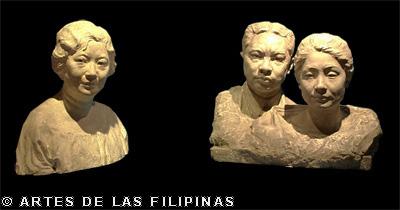
Pasig City Museum
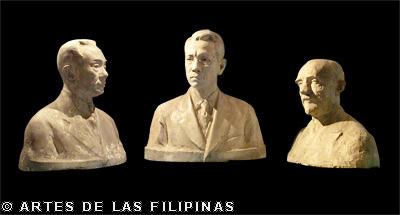
In 1911, while he was still in high school, he made a group of drawing of Rizal, Burgos, Antonio and Juan Luna, Regidor and others. His Tata Pepe, with whom he was living, succeeded in interesting Severino Reyes to have the drawing lithographed. It was then published in Liwayway, whose editor was Reyes, under the title Grupo de Filipinos Ilustros. Although Tolentino never made a centavo out of the drawing, he was pleased to see his work in people’s homes everywhere.
Pasig City Museum
While studying at the School of Fine Arts, he supported himself by doing works for various marmolerias in Manila. In 1914, he did his first important work for architect Juan Arellano. The figure is that of a woman praying against a cross for the tomb of the Palma family in Cementerio del Norte. The same year, he executed the relief figures designed by Arellano on the facade of Casino Español on Taft Avenue.
In 1915, he graduated in Painting and Sculpture in the School of Fine Arts, with prizes in all subjects taken. However, he decided to stay for another year. During this time, he rendered the monument of San Miguel de Mayumo representing the Pact of Biak na Bato. Juan Arellano designed it.
Tolentino spent the year 1918 principally in Laguna. There, he worked with the contractor Tomas Zamora making monuments of Rizal, a mausoleum, and others. His friends, especially Precioso Palma, urged him to open up a shop of his own. They even offered him money to enable him to do so. He would not accept. When asked why, he quitely answered, “Because I was not yet a scupltor” (Paras-Perez, 1972).
Soon, he decided to go to America. In 1919, he arrived in Washington, D.C. He worked as a waiter in a cafe in Rock Creek Park. Inspired by President Woodrow Wilson’s work for peace, he created a small statue symbolizing “peace” – hoping someday he may be able to present it to the President. He confided this to the manager who later spoke of the matter to the private secretary of Mrs. Wilson, who used to frequent the cafe. Shortly, Tolentino secured an audience with President Wilson at the White House, marking the turning point in the beginning of his carrer.
With $300 savings, he went to New York to further his studies. Some months after he arrived in New York, he received a letter from Bernard Baruch, an American millionaire. Baruch said that he saw the Peace statue made by Tolentino and he was willing to grant him scholarship. Thereupon, he enrolled at the Ecole de Beaux Arts for advanced courses in scuplture. While studying, he worked as messenger and assistant to American scupltor Gutzon Borglum, earning $11 a week. In 1921, he finished his course at the Ecole de Beaux Arts with monetary, medal, and diploma awards. That same year, he left for Europe.
Tolentino stayed in London for a week, visiting museums and art galleries. He went on to Paris and stayed there for anothe week. Then, he moved to Rome where he spent the next three and a half years. There he entered the Regge Instituto Superiore di Belle Arti di Roma.
After a year, the money he had been able to save in New York ran out. He wrote to Jaime de Veyra, Resident Commissioner in Washington, to say that he was having difficulty finding a job in Rome. De Veyra wrote to his friends in the Philippines; some of the Manila newspapers took the matter up, and about Php 800 was raised for Tolentino. Giovanni Lammoglia, head of the Italian colony in Manila, also pensioned him for one year.
In Rome, he created the Saluto Romano and won the second prize in a sculptural competition for his study of The Four Horsemen of the Apocalypse. In 15 October 1923, he graduated from the Regge Instituto Superiore di Belle Arti di Roma with highest honor – Licenziato del Corso Superiore Librero di Scultura. He also held a one-man exhibition in Rome after he graduated.
In 1925, he sailed for home. He took a homebound boat belonging to the Campana Tabacalera de Filipinas travelling from Barcelona. The vessel offered him second class passage for free. He opened his studio in Manila on January 24. In 1926, University of the Philippines President Rafael Palma appointed him instructor in sculpture at the U.P. School of Fine Arts.
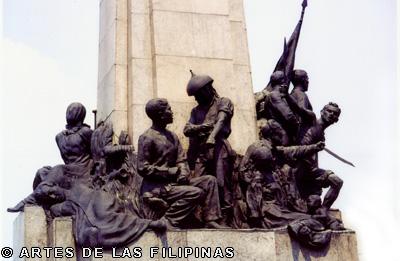
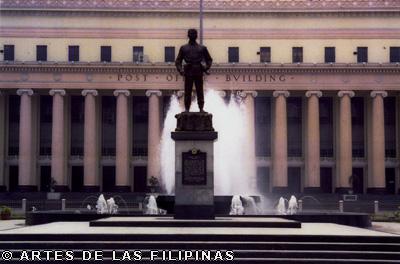
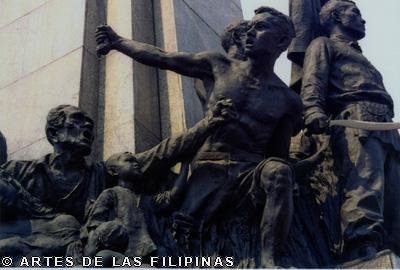
On 9 August 1930, a jury, created to select the best design honoring the Supremo of the Katipunan, met. The designs were entered under pseudonyms. The winning entry was under the pseudonym of Batang Elias – Tolentino was Batang Elias. He won the design for the Bonifacio Monument and was granted a commission for its installation. He completed the figures for the monument in 1932. Then, he sent the figures to Italy for bronze casting. In 1933, he completed the Bonifacio Monument.
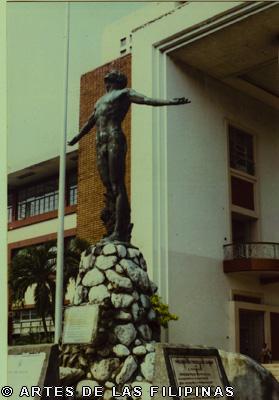
Tolentino worked on the Oblation at about the same time he did the Bonifacio Monument. He made the Oblation an amalgam of the solid physique of Anastacio Caedo, his sculptor/assistant, and the height and proportion of Virgilio Raymundo, Caedo’s brother-in-law.
UP President Rafael Palma commissioned the monument. In 1935, the Oblation was unveiled on its original site in the Padre Faura Quadrangle at U.P. Manila. It was later transferred to U.P. Diliman in 1949. Today, the Oblation becomes the symbol of academic freedom in U.P.
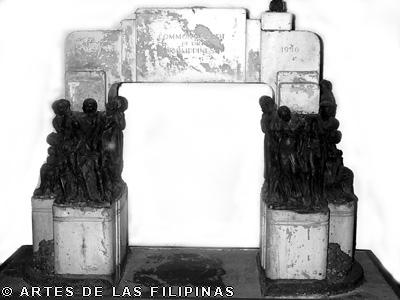
On 25 October 1935, the U.P. Alumni Association announced its plan to construct an arch to commemorate the inaguration of the Commonwealth of the Philippines. They requested Tolentino to prepare the design and the maquette.
It did not take long for Tolentino to produce a maquette. President Quezon and the National Assembly approved the design. The cost of the monument was set at about Php 500,000. Funds were short but on 15 November 1938, Mrs. Aurora Quezon laid the first trowel-full of cement on the monument’s foundation. The Commonwealth Triumphal Arch was supposed to be placed at the intersection of Padre Burgos and Taft Avenue in front of the Legislative Building. Unfortunately, the war got in the way and the triumphal arch was never built.
On 23 July 1951 during the absence of Fernando Amorsolo, Tolentino was appointed Acting Director of the School of Fine Arts. On 4 August 1953, he was appointed Director.
After twenty-nine years of service to the University, Tolentino returned to private practice in 1955. Following his retirement, the U.P. Board of Regents named him Professor Emeritus. In the same year, the Philippine Institute of Architects declared him Scupltor of the Year.
Moreover, he received various awards and citations in the field of sculpture. In 1959, he received the UNESCO Cultural Award in Sculpture. In 1963, he obtained the Araw ng Maynila Award in Sculpture. In 1970, he was also conferred the President’s Medal of Merit for contributions to nation building through his outstanding work in arts particularly in sculpture.
Tolentino also received the Republic Cultural Heritage Award in 1967 for his contribution in preserving, developing, and enriching the Filipino culture. In 1972, he was given the Diwa ng Lahi Award, the highest honor in the week long Linggo ng Kalinangan celebration in Manila. Futhermore, the First Lady Imelda Romualdez Marcos awarded him a plaque in 4 March 1973 for his meritorious services rendered in the advancement of art in the Philippines.
Likewise on 12 June 1973, Tolentino received the National Artist Award pursuant to Proclamation No. 1144 dated 14 May 1973, in recognition of his rare excellence and significant contribution in sculpture.
On 12 July 1976, twelve days before his 86th birthday, Guillermo E. Tolentino died at 8:00pm at the age of eighty-five in his house at 2102 Retiro Street.
REFERENCES
“Forgotten Triumphs.” The Philippine Star. October 2002, Modern Living Section, pp. F1-F3
“Oblation to a Nation.” The Philippine Star. June 2002, Modern Living Section, pp. ML 17-ML19
Paras-Perez, Rodlfo. Edades and the 13 Moderns. Manila: Cultural Center of the Philippines and National Commission for Culture and Arts-Commitee on Visual Arts, 1995.
___________. Guillermo Tolentino. Philippines: Zone-D Art Publications, 1972
___________. Tolentino. Documentation by Florina H. Capistrano. Philippines: Rodolfo Paras-Perez and the National Art Foundation of Malolos, 1976
Lilimay R. Manalo-Castor is an MA Art History student at the University of the Philippines, Diliman. She is currently preparing for the defense of her thesis on public sculptures. She is working at the Pasig City Museum as Museum Curator, concurrent with her position as Tourism Operations Officer I of Pasig. She is a member of the Pasig City Heritage Conservation Committee (PCHCC) and the Philippine Association of Museums, Inc. (PAMI).