
A Guide to Malacañan’s Presidential Museum and Library
by the Malacañan Palace Museum Library Staff
July 2012–The Presidential Museum and Library is located in Kalayaan Hall, originally built in 1921 during the American colonial era as the Executive Building and today a wing of Malacañan Palace, the historic and official seat and residence of the President of the Philippines. The Museum exists to afford public visitors the opportunity to visit the headquarters of the executive department and promote an appreciation not only of the history, role and heritage of Malacañan Palace from its 18th century beginnings in Spanish colonial times across to the present day, but also of the great institution of the Philippine presidency and the legacies of the fifteen Filipinos who to date have held highest office in the land.

Isabelo Tampinco carved the wooden ceiling at the Kalayaan Hall
At Kalayaan Hall, reached through the historic Commonwealth-era Harrison Gate of Malacañan Palace, the Presidential Museum and Library is housed in some of the most historically important and architecturally significant rooms in the Philippines. Indeed, these rooms, many restored under the Arroyo administration, continue to play a role in official life. Noteworthy furniture, artwork, memorabilia and items from the collections of the Palace as well as private institutions and individuals have been assembled to form a unique and substantial exhibition for visitors. The building itself, designed by Ralph Harrington Doane in elegant neo-Renaissance style, is one of the finest examples of American colonial public architecture in the country, and one of the best-preserved today.
The rooms on the ground floor, most of them paneled in hardwood and sumptuously carved by the most renowned of Filipino woodcarvers, Isabelo Tampinco, housed the Executive Bureau during the American Period, and are today devoted to the colonial-era history of Malacañan Palace.
The Old Waiting Room

The first of these rooms is the Old Waiting Room Gallery, which features relics and items evoking the Spanish era (c. 1750s-1898), during which the Palace was established, first as a private country home (c. 1750s -1825), then as state owned retreat of the Governor-General (1825-1847), his official summer residence (1847-1863) and finally, as a result of a great earthquake that devastated the walled city of Manila, the official seat of the “First Authority” (1863-1898). The Governors-General here are from these later periods and significant to the Palace’s history and evolution, including Narciso Claveria (1844-1849), Fernando Norzagaray (1857-1860), Rafael de Echague (1863-1865), Carlos Maria de la Torre (1869-1871), Rafael de Izquierdo (1871-1873), Jose Malcampo (1874-1877), Domingo de Moriones (1877-1880), Joaquin Jovellar (1883-1885), Emilio Terrero (1885-1888), Valeriano Weyler (1888-1891), Eulogio Despujol (1891-1893), Ramon Blanco (1893-1896), Camilo Garcia de Polaviaeja (1896-1897), Fernando Primo de Rivera (1880-1883; 1897-1898), and Basilio Augusti (1898) – the last Spanish resident of the Palace.
The Old Executive Secretary’s Office
The Old Secretary’s Office Gallery contains an exhibit on the era of Reform, Revolution and the First Philippine Republic (c. 1860s – 1901), during which many heroes of the Philippines had fateful encounters at Malacañan Palace, starting with the reformist liberals who were entertained here in the late 1860s and, shortly after, brutally suppressed following the Cavite Mutiny of 1872. The National Hero Jose Rizal, was an occasional visitor in his advocacy for reform and progress and the exhibit features a significant quantity of rare Rizaliana from the Palace collections, as well as items related to such personages as Apolinario Mabini, Felix Resurrection Hidalgo, Maximo Viola and Ferdinand Blumentritt. With the outbreak of the Philippine Revolution in 1896 and the establishment of the First Philippine Republic in 1899 (after the overthrow of Spanish rule by the United States the previous year), Filipinos were fighting a war for independence, substantially ended only after President Emilio Aguinaldo (1899-1901) was captured and brought to Malacañan Palace. After being held under house arrest, he dissolved the Republic on April 1, 1901.

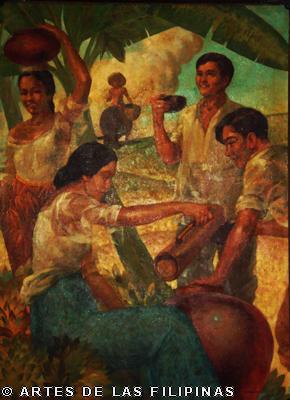
An Illustration by Fernando Amorsolo
The Old Governor-General’s Office
By this time, American Authority was long established at the Palace, starting with Military Governors Wesley Merrit (1898), Elwell S. Otis (1898-1900) and Arthur MacArthur (1900-1901). The era of American rule (1898-1935) is the focus of the Old Governor General’s Office Gallery and includes the subsequent civil government that was inaugurated on July 4, 1901 under William Howard Taft (1901-1904). All the military and civil governors lived at the Palace; after Taft came Luke E. Wright (1904-1906), Henry Clay Ide (1906), James F. Smith (1906-1909), William Cameron Forbes (1909-1913), Francis Burton Harrison (1913-1921), Leonard Wood (1921-1928), Henry Stimson (1928-1929), Dwight F. Davis (1929-1932), Theodore Roosevelt, Jr. (1932-1933), and Frank Murphy (1933-1935). Harrison was responsible for the construction of the Executive Building, and Malacañan Palace from 1921 onward hosted the offices of the executive as well as the residence of the Governor-General.
The Osmeña Cabinet Room
The old Cabinet Room, with its faux-stone stuccoes walls and unique cement frieze – also by Tampinco – featuring Filipino landscapes amid cherubs, eagles and sea lions, was where the American-era Cabinet and Council of State met. It has been renamed the Osmeña Cabinet Room (1944-1946), who during much of this period, as Speaker of the Philippine Assembly (later the House of Representatives) and member of the Council of State, was considered the leading representative of the Filipino people.
The West Staircase

The West Staircase Gallery, leading to the second floor, features the history of the Palace during the transitional period of autonomy under the Commonwealth of the Philippines (1935-1946), appropriate since many of the rooms on the second floor date from this period – specifically from the presidency of Manuel L. Quezon (1935-1944) – which also saw the enlargement, embellishment and conversion of the into something fit for the seat of a Head of State. This is what it indeed became after the scheduled proclamation of Philippine independence from the United States on July 4, 1946 established the Third Republic. Historic architectural plans of alterations and additions to the Palace from the old Bureau of Public Works have been preserved and put on display together with photographs and other items. At the top of the staircase are three historic state rooms and the West Loggia that were built when Executive Building was enlarged in 1937 side wings.
The Quezon Executive Office
The first of the state rooms is the Quezon Executive Office, which served as the President’s Office – the formal office, as opposed to the Presidential Study in the Palace proper used officially today – from 1937-1981. Said to have been the first air-conditioned office in the country, the room is named by proclamation after the man who first used it, and today features the original presidential desk, elaborately carved by Vidal Tampinco, who also sculpted the wood or plaster ornamentation throughout these rooms. The first state portrait of President Manuel L. Quezon, by Leon Gordon, which hung in the Reception Hall of the Palace from 1937 to 1979, is featured on the main wall. The room is today preserved as executive office, with the national and presidential flags, as well as the seal of the president displayed in accordance with protocol.
Quirino Council of State Room
The old Council of State Room was named by proclamation for President Elpidio Quirino (1948-1953), who, being Vice-President (and the first secretary of Foreign Affairs) took his first oath of the office as President here in 1948 after the sudden death of President Manuel Roxas (1946-1948). President Carlos P. Garcia (1957-1961) also took his first oath of office as President here in 1957 after the plane crash that claimed the life of President Ramon Magsaysay (1953-1957), under whom he was Vice-President. From the Quezon to Marcos administrations, many cabinet meetings as well as conferences and other ceremonies of state were conducted in this room. In 1981, the room was modified to serve as the President’s broadcast studio, and was restored to its original appearance in 2002. The Commonwealth-era conference table and console table beneath President Quirino’s portrait by Fernando Amorsolo are original to the room. This room is the large and famous painting by Spanish impressionist artist Joaquin Sorolla. Entitled “Las Neriedas” – “The Nereids” – this 1886 canvas was donated to the Palace during the term of President Quirino by Alma de Bretteville Spreckels, an American heiress and philanthropist.
The Roxas Cabinet Room
Also built 1937, this room was known and used as the Cabinet Room until it was converted into part of the presidential television studio in early 1981. As the last president who, from 1946 to 1948, used the room for cabinet meetings, and as one of the few rooms to distinctly date from his period of national service, the room was named by proclamation after President Manuel Roxas in 2003. It is today preserved as a meeting room, featuring objects evoking the early Third Republic and President Roxas together with a portrait of the President by Amorsolo. The chair is that used by President Ferdinand E. Marcos (1965-1986) in the Presidential Study in the Palace. President Fidel V. Ramos (1992-1998) also used this as his official chair throughout his term.
Main Hall and Library – Gallery of Presidents

The Main Hall and Library
The large Main Hall and Library was once the location of eight guest bedrooms during the American era, and then of myriad offices during the Commonwealth. In late 1968 all this was cleared at the initiative of First Lady Imelda Romualdez Marcos and renovated to form a large room called Maharlika Hall. It became the site for State Dinners and Citizen’s Assemblies during the Marcos administration. Much later, it was from the front west balcony of this hall that President Marcos took his last public oath of office and delivered his farewell speech on February 25, 1986. Today, the hall houses the main part of the library, with parts of the old state dining table in the center, as well as the Gallery of Presidents, which is composed of objects and memorabilia – including clothing, personal effects, gifts, publications and documents – pertaining to the fifteen persons who have held the Presidency. Emilio Aguinaldo (1899-1901), Sergio Osmeña (1944-1946), Manuel Roxas (1946-1948), Elpidio Quirino (1948-1953), Ramon Magsaysay (1953-1957), Carlos P. Garcia (1957-1961), Diosdado Macapagal (1961-1965), Ferdinand Marcos (1965-1986), Corazon C. Aquino (1986-1992), Fidel V. Ramos (1992-1998), Joseph Ejercito Estrada (1998-2001), Gloria Macapagal Arroyo (2001-2010) and President Benigno S. Aquino, III (2010 – present). Other objects to be found in the hall include artworks and furniture from the Palace collections, a display of the history of the Palace during the Third Republic (1946-1981) and fourth Republic (1981-1986) and a selection of items from the Presidential Museum collection arrayed on the old state dining table.
The Northeast Gallery

The Cabinets on the right contain the books collected and read by
President Ferdinand Marcos
In the Northeast Gallery is displayed the office furniture set by former President Ferdinand E. Marcos from the late 1970’s until his disposition in 1986. On the walls are oil portraits and photographs of the Philippines vice President from Sergio Osmeña to Jejomar Binay.
The Southeast Gallery

A wooden sculpture of St.Michael Killing the Dragon
by an unknown sculptor in Paete, Laguna; Behind are
drawings by Ireneo Miranda

It features the memorabilia of the late President Corazon C. Aquino, 11th President of the Philippines. On display are photographs, paintings the awards she received during and after her presidency, campaign materials, and other artworks evoking the life and achievements of the first women president of the nation.
The East Staircase

A Portrait of the Former First Lady Imelda Marcos

One of Edsa 1’s valuable relics is the blackboard on which Fabian Ver
and other generals who remained loyal to President Marcos drew up
their plan of attack against Camp Crame

The Balcony where the Marcos Family Bade Their Supporter Farewell
The East Staircase Gallery presents portraits of President Ferdinand E. Marcos (1965-1986) and first Lady Imelda Romualdez Marcos, as well as other canvases. These are followed by items relating to the EDSA People Power Revolution (February, 1986). The revolution, which took place along Epifanio de los Santos Avenue (popularly known as “EDSA”) in Quezon City, culminated on February 25, 1986 with the departure of the Marcos family from Malacañan Palace. Earlier that day, he had taken his oath of office as president (having been proclaimed the winner of presidential elections against Corazon Aquino that were widely regarded as Fraudulent) and then emerged on the balcony of Maharlika Hall to address his supporters. Later that same evening, pro-democracy protestors occupied Maharlika Hall, the name to which President Marcos had given to the old Executive Building. Soon after being swept to power, President Aquino, in honor of this landmark event in the history of the nation that paved the way for the new Fifth Republic, renamed the building Kalayaan Hall, after the Filipino word for “freedom”. This great event, two decades ago, fittingly marks the end of the Museum’s narrative of the history of Malacañan Palace, symbol of Filipino sovereignty, independence, liberty and progress.
Photographs taken by Christiane L. de la Paz